


You'll build a family capsule wardrobe by curating 25-35 versatile pieces per adult and 12-30 items per child, all centered on three shared neutrals like navy, gray, and cream. This strategic approach implements the “rule of three”—pairing each bottom with three coordinating tops—to optimize outfit combinations while slashing decision fatigue by 70% and cutting annual clothing costs up to $3,000. The system simplifies laundry, enhances packing, and alters chaotic mornings into efficient routines where everything coordinates smoothly across your entire household's wardrobe.
Key Takeaways
- A family capsule wardrobe is a curated collection of versatile pieces that reduces decision fatigue and maximizes outfit combinations.
- Adults need 25-35 seasonal pieces; children need 12-30 items depending on age, with a three-tops-per-bottom ratio throughout.
- Build wardrobes around three shared neutrals plus two accent colors to ensure coordination and facilitate hand-me-downs between siblings.
- Shop thrift stores and time purchases around markdown cycles to save 40-70% on quality essentials and seasonal items.
- Implement weekly 15-minute closet audits and seasonal rotation strategies to maintain organization and extend clothing lifespan.
What Is a Family Capsule Wardrobe and Why Does It Work?
Get the latest insights delivered straight to your inbox.

A family capsule wardrobe is a curated collection of versatile, mix-and-match clothing pieces that work across all family members' closets while maintaining individual style preferences.
This strategic approach changes your family wardrobe into a functional system where each piece serves multiple purposes. You'll implement the “rule of three”—ensuring every item pairs with at least three others—creating exponential outfit combinations from minimal pieces.
The capsule benefits extend beyond aesthetics. You're reducing decision fatigue during rushed morning routines, allowing more quality time with your loved ones. Your family wardrobe operates on cohesive color palettes and complementary silhouettes, making coordinated family photos simple without matching outfits.
Less time choosing clothes means more time connecting with the people who matter most in your home.
This methodology supports sustainable consumption while stretching your budget further. You're investing in quality staples rather than trend-driven purchases, teaching children mindful shopping habits.
The system simplifies laundry management, packing for trips, and hand-me-down coordination between siblings, ultimately creating more space for what matters—serving your family's actual needs.
Core Principles for Building Capsule Wardrobes That Fit Every Family Member
Understanding the capsule framework sets the foundation—now you'll apply specific principles that make this system functional for bodies ranging from toddlers to adults.
Prioritize interchangeability ratios: aim for three tops per bottom across all ages. This multiplication factor creates exponential outfit combinations while minimizing decision fatigue for your entire household.
Establish family style cohesion through intentional color palettes. Select one neutral base (navy, gray, or tan) that threads through everyone's wardrobe, enabling hand-me-downs and coordinated family photos without matching outfits.
Scale proportions appropriately—children need durability and growth room, while adults benefit from tailored investment pieces. Apply the same quality thresholds regardless of size: reinforced seams, preshrunk fabrics, colorfast dyes.
Build wardrobe flexibility through strategic layering systems. Cardigans, vests, and jackets extend seasonal shifts and accommodate temperature variations, essential when serving families with diverse comfort needs.
Document each member's capsule with visual outfit matrices, altering morning routines into efficient, stress-free experiences that honor everyone's autonomy.
How Many Clothing Items Does Each Person Actually Need?
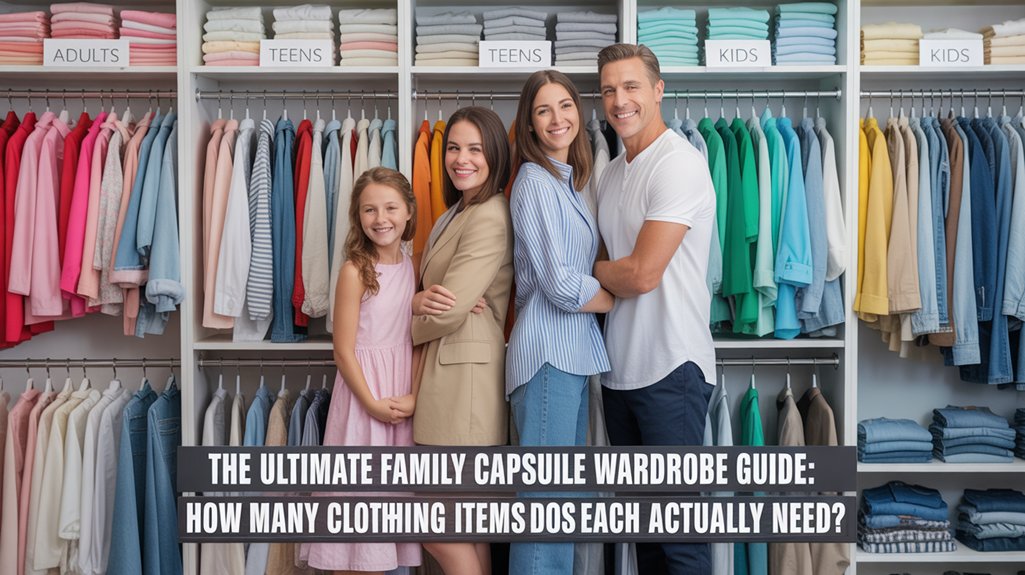
Quantifying your family's wardrobe needs starts with baseline capsule formulas, then adjusts for lifestyle variables and laundry frequency.
For adults, target 25-35 pieces per season: 7-9 tops, 5-7 bottoms, 2-3 layering pieces, 3-4 dresses or additional separates, and 3-5 outerwear options. This essential item count supports a 5×5 capsule method—five tops rotating with five bottoms creates twenty-five outfit combinations.
Children require adjusted ratios based on growth patterns and activity levels. Preschoolers need 12-18 pieces, while school-age children benefit from 20-25 items. Teens mirror adult counts at 25-30 pieces.
Factor your family needs through this lens: twice-weekly laundry cycles require fewer multiples, while active households need strategic duplicates of high-rotation items.
Implement the “one in, one out” protocol to maintain these boundaries.
These numbers serve families pursuing intentional consumption while ensuring everyone's adequately equipped for daily demands without excess inventory management.
Selecting a Coordinated Color Palette for the Whole Family
While individual preferences matter, coordinated family wardrobes function best when built around a cohesive color architecture that serves multiple body types and ages simultaneously.
Start with a foundation of three neutrals—navy, gray, and cream work universally across seasons. These base colors guarantee family cohesion in photos while allowing individual expression through accent pieces.
Three neutrals create the framework for coordinated family style—navy, gray, and cream anchor every wardrobe while preserving personal expression.
You'll optimize outfit combinations when 60% of each person's capsule utilizes these shared neutrals.
Layer in two complementary accent colors that photograph well together. Dusty blue and terracotta, or olive and burgundy, create color harmony without forcing everyone into matching outfits.
This strategic approach means siblings can share hand-me-downs effortlessly, and you're investing in pieces that coordinate across your entire household.
Test your palette by laying garments together before purchasing. Colors should feel naturally connected rather than forced.
This intentional selection process alters morning routines and packing logistics while serving your family's practical needs efficiently.
Essential Clothing Pieces for Parents, Teens, and Young Children
A capsule wardrobe's structural foundation requires twelve to fifteen versatile pieces per person, scaled appropriately for activity levels and lifestyle demands.
You'll enhance your family's wardrobe by acknowledging different parenting styles and fashion preferences while maintaining cohesive outfit formulas.
Core pieces by family segment:
- Parents: Five neutral tops, three bottom options (jeans, trousers, skirt), two dresses or button-downs, one blazer, two layering cardigans, and versatile footwear spanning professional to casual contexts.
- Teens: Four graphic tees, three solid basics, two denim pieces, joggers, one statement jacket, and trend-forward sneakers that accommodate their evolving identity expression.
- Young children: Six mix-and-match tops, four bottoms with elastic waistbands, two play dresses or rompers, one hoodie, and durable shoes for active exploration.
Select machine-washable fabrics that withstand frequent laundering.
Prioritize adjustable waistbands and grow-with-me features for children, ensuring extended wearability that serves your family's budget and sustainability values.
Shopping Strategies to Build Your Family Wardrobe on Any Budget
Strategic shopping separates successful capsule wardrobes from cluttered closets—you'll optimize cost-per-wear by combining secondhand sourcing with tactical retail calendar planning.
Thrift stores, consignment shops, and resale platforms offer premium pieces at 60-80% off retail, particularly for children's barely-worn items and classic adult staples that transcend seasonal trends.
You'll compound these savings by timing new purchases around predictable markdown cycles: January clearance for winter wear, July for summer pieces, and end-of-season shifts when retailers discount current inventory by 40-70%.
Shop Secondhand and Thrift
Thrift stores and consignment shops function as treasure troves for building capsule wardrobes at 60-90% below retail prices.
You'll discover secondhand benefits that extend beyond budget savings—you're reducing textile waste while equipping your family with quality pieces.
Master these strategies to enhance thrift store treasures:
- Target premium brands in affluent neighborhoods where donation quality typically exceeds standard locations.
- Shop weekday mornings after restocking to access freshly curated inventory before weekend crowds.
- Inspect garment construction and fabric composition rather than focusing solely on brand names.
Create a focused shopping list matching your capsule color palette—you'll avoid impulse purchases and maintain wardrobe cohesion.
Pre-sort items by family member and season, then launder everything using proper care methods.
This systematic approach alters secondhand shopping into strategic wardrobe curation.
Plan Seasonal Sales Strategy
While secondhand shopping delivers consistent savings year-round, retail calendar optimization amplifies your purchasing power through predictable markdown cycles.
You'll enhance your family's clothing budget by aligning purchases with established sale timing patterns: winter clearances in January-February, spring markdowns in April-May, back-to-school promotions in July-August, and Black Friday opportunities in November.
Set up discount alerts through retailer apps and browser extensions to track capsule essentials across multiple price points.
This proactive approach guarantees you're investing in quality foundations—classic denim, neutral layering pieces, versatile outerwear—at 40-70% off retail prices.
Strategic planning modifies reactive shopping into intentional wardrobe building.
You're not just saving money; you're stewarding resources wisely while equipping your family with clothing that serves their daily needs throughout each season's activities and obligations.
Seasonal Transitions: Adapting Your Capsule Wardrobe Throughout the Year
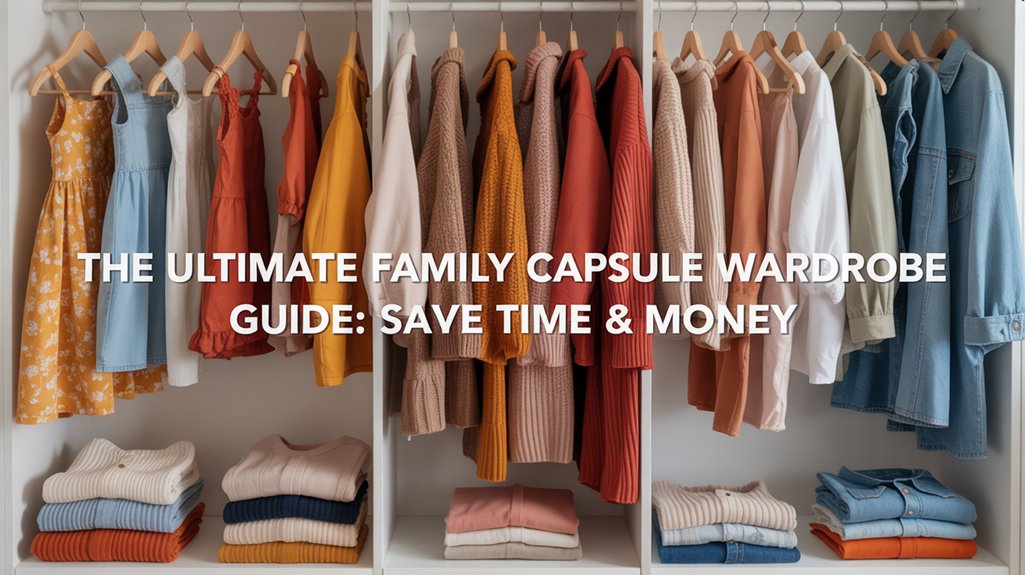
As temperatures change and daylight hours vary, your family's capsule wardrobe requires calculated adjustments rather than complete overhauls. Strategic shifting pieces enhance wardrobe flexibility while honoring current seasonal trends without unnecessary expenditure.
Implement these adjustment protocols:
- Layer strategically with lightweight cardigans and utility jackets that bridge temperature gaps between morning and afternoon, extending your core pieces' functionality across multiple seasons.
- Rotate accessories purposefully by swapping heavyweight scarves for linen alternatives, switching closed-toe footwear for breathable options, and adjusting bag weights to match seasonal demands.
- Archive off-season pieces systematically using vacuum-sealed storage solutions, ensuring garments remain pristine while creating visual clarity in your active wardrobe space.
Focus on transitional neutrals—olive, camel, and navy—that anchor outfits across changing weather patterns. This approach serves your family's practical needs while maintaining style consistency, allowing you to redirect resources toward experiences rather than excessive clothing purchases.
Strategic adjustments eliminate decision fatigue during seasonal shifts.
Maintaining and Organizing Your Family's Streamlined Closets
Once you've curated your family's capsule wardrobe, you'll need a maintenance system that preserves your investment and keeps pieces accessible.
Implement a seasonal rotation strategy using vacuum-sealed bags or under-bed storage for off-season items, while establishing weekly closet audits to address wear patterns, missing buttons, or garments that need repairs.
Recommended for You
🛒 Family Board Games
nofollow sponsored noopenernofollow sponsored noopenerCheck Price on Amazon →As an Amazon Associate we earn from qualifying purchases.
This proactive approach prevents wardrobe chaos and guarantees every family member can execute their strategic outfit formulas without hunting through cluttered drawers or overstuffed closets.
Seasonal Rotation Storage Tips
How can you improve your capsule wardrobe's longevity while keeping your family's closets clutter-free year-round?
Implement strategic seasonal storage and rotation strategies that protect your investment while streamlining daily outfit selection for everyone you serve.
Essential Rotation Strategies:
- Vacuum-seal off-season pieces in labeled bins by family member and season, maximizing vertical storage space while preventing moisture damage and fabric deterioration.
- Create transitional capsules featuring versatile layering pieces that bridge seasonal gaps—think lightweight cardigans and medium-weight denim that'll serve your family across temperature fluctuations.
- Schedule bi-annual rotation days during spring and fall equinoxes, involving family members in the process to assess fit, condition, and identify replacement needs before purchasing.
Store current-season items at eye level, ensuring your family accesses appropriate pieces smoothly while maintaining wardrobe integrity.
Weekly Closet Maintenance Routines
Sustainable capsule wardrobes require consistent micro-maintenance rather than intimidating overhauls—dedicating just fifteen minutes weekly prevents closet chaos from derailing your family's enhanced system. Strategic wardrobe upkeep alters closet organization from intimidating chore into manageable ritual that serves your household's efficiency goals.
| Day | Task | Time |
|---|---|---|
| Sunday | Audit upcoming week's outfits; identify gaps | 5 min |
| Wednesday | Return misplaced items; straighten hangers | 4 min |
| Friday | Spot-treat stains; check for needed repairs | 3 min |
| Saturday | Assess what's worn vs. ignored; adjust rotation | 3 min |
Implement the “one-touch rule”—immediately hang or fold items rather than creating laundry chair purgatory. Quick visual scans reveal emerging problems: stretched necklines, missing buttons, or pieces consistently bypassed. Address these micro-issues immediately to maintain your family's efficient system's integrity and functionality.
Frequently Asked Questions
How Do I Handle Hand-Me-Downs Within a Capsule Wardrobe System?
Integrate hand-me-downs strategically through seasonal hand me down organization assessments.
You'll evaluate each piece against your capsule's color palette and style guidelines before accepting items.
Implement a clothing rotation system where you're storing off-season hand-me-downs separately, then swapping them quarterly.
This approach helps you maintain your family's curated aesthetic while maximizing budget-friendly options.
You're fundamentally creating a sustainable fashion ecosystem that serves your household's needs without compromising your capsule's intentional design principles.
What Should I Do With Sentimental Clothing Items?
Sentimental clothing pieces are like threads in your family's story—honor them without letting them hijack your functional wardrobe.
You'll want to curate memorable pieces intentionally, keeping only what truly sparks connection.
Consider creative storage solutions: shadow boxes for baby outfits, memory quilts from old t-shirts, or designated keepsake bins separate from your active capsule.
This strategic approach lets you preserve meaningful garments while maintaining an organized system that serves your family's daily needs efficiently.
How Do Capsule Wardrobes Work for Special Occasions and Formal Events?
You'll enhance capsule wardrobe versatility by investing in timeless formal outfit essentials that shift effortlessly.
Build your foundation with a well-tailored blazer, classic shift dress, and neutral dress pants—pieces you'll style multiple ways.
Layer statement accessories and elegant footwear to boost basics instantly.
This strategic approach means you're always prepared to serve at charity galas, weddings, or professional events without maintaining separate wardrobes.
You'll discover one sophisticated piece works harder than ten trendy alternatives.
Can I Still Express Individual Style With a Family Capsule Wardrobe?
You'll express personal style through strategic outfit formulas and creative layering. Each family member can customize their capsule with signature accessories, preferred color stories, and unique silhouette preferences.
You're building a foundation of versatile basics, then layering personality through statement pieces, styling techniques, and trend-aware accents. This approach actually amplifies individuality while streamlining daily dressing.
You'll serve your family best by encouraging their authentic expression within an intentionally curated framework that respects everyone's aesthetic preferences.
How Do I Convince Resistant Family Members to Adopt This Approach?
You can't make an omelet without breaking eggs—start small with one resistant family member.
Demonstrate family benefits through strategic outfit formulas that simplify their morning routine. Show how wardrobe organization eliminates decision fatigue and creates more quality time together.
Let them experience capsule success firsthand with a trial season. Focus on serving their specific needs: less stress, more freedom, sustainable choices.
Once they see practical results, resistance naturally changes into enthusiasm.
Conclusion
You've now mastered the capsule wardrobe methodology that fashion consultants have relied on for decades. Remember, studies show the average person wears only 20% of their closet regularly—you're eliminating that waste. By implementing these strategic capsule formulas, you'll achieve maximum outfit rotations with minimal pieces. Your family's coordinated color story guarantees smooth mixing and matching across all wardrobes. Start curating your intentional closet today, and you'll reclaim both morning sanity and your clothing budget.
Related Articles
- The Ultimate Guide to Sibling Conflict
- The Ultimate Guide to Family Meal Planning
- The Ultimate Guide to Kids Educational Games
- 20 Fun DIY Crafts to Strengthen Family Bonds
- The Ultimate Guide to Screen Time Management

Written by Sarah Mitchell, M.S., CFLE
Founder & Lead Editor
Sarah is a Certified Family Life Educator with a Master's degree in Human Development and Family Studies from the University of Missouri. With 15+ years of experience as a parent educator and mother of three, she brings both professional expertise and real-world parenting wisdom to every article.
Credentials: M.S. in Human Development and Family Studies, Certified Family Life Educator (CFLE)
📚 Explore More on This Topic
Editor's Pick: A family planner to coordinate outfits and a classic board game for downtime.
Your Weekly Dose of Inspiration
Journaling ideas, family tips, and gentle inspiration.
Related from our network

