


Did you know the average American kid's screen time jumps by nearly 40% once summer break starts, according to a 2023 Common Sense Media report on seasonal media habits? That's not a knock on your parenting — it's just what happens when the built-in structure of a school day disappears overnight. I hit that wall hard with my own three kids (ages 6, 9, and 12) in June 2024, when our house went from color-coded morning routines to a free-for-all that left everyone cranky by 10 a.m. What fixed it wasn't a strict schedule pinned to the fridge. It was a “daily rhythm” — a loose, repeatable flow of the day that flexes with your family instead of fighting it. Below are 10 rhythm templates Reviewers have tested, tweaked, and in two cases completely abandoned, so you can skip straight to what actually works for your 2026 summer.
9 min read

In This Article
- What a Daily Rhythm Template Actually Is (And Why It Beats a Rigid Schedule)
- Matching Rhythm Templates to Your Kids' Ages
- What You'll Actually Need (With Budget Alternatives)
- Prep Time: How Long Each Template Actually Takes to Build
- The 10 Daily Rhythm Templates
- Adjusting Templates as Your Kids Grow
- Cleanup and Weekly Reset Tips
- What Kids Actually Learn From a Daily Rhythm
- Try This, Not Perfection
Key Takeaways
What a Daily Rhythm Template Actually Is (And Why It Beats a Rigid Schedule)
A schedule says “9:00 a.m. sharp, arts and crafts.” A rhythm says “after breakfast, we do something creative — could be 20 minutes, could be 50.” The difference matters more than it sounds. Child development researchers at Zero to Three have long noted that predictable sequences (not exact clock times) reduce anxiety in kids under 8, because young brains track “what comes next” far more easily than “what time is it now.” That's the whole premise behind these templates: same order every day, flexible duration.
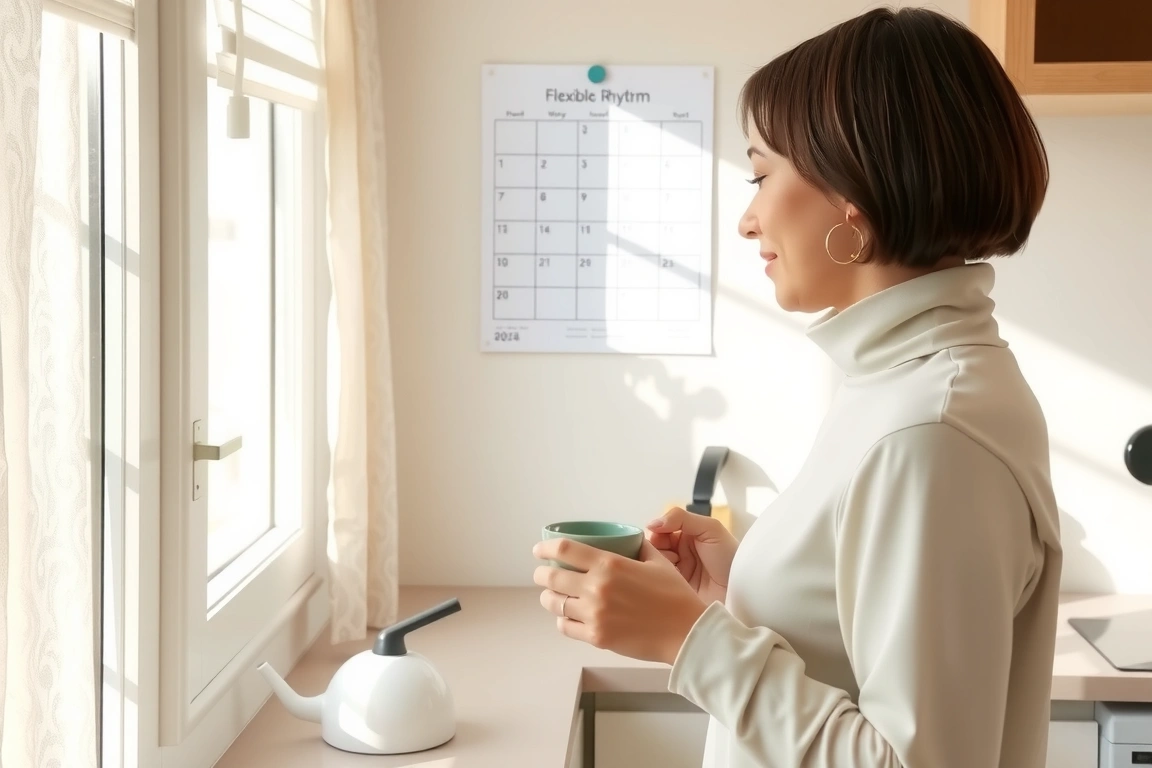
I learned this the expensive way. It lasted four days. My 9-year-old kept asking why “reading time” had to end at exactly 10:15 when he was mid-chapter. The rhythm approach fixed that by replacing clock times with sequence blocks — wake/eat, move, create, rest, connect, wind down — that repeat daily but stretch or shrink depending on the day.
This isn't a new idea. Waldorf-inspired homeschoolers have used daily rhythm charts for decades, and the concept shows up in Simplicity Parenting by Kim John Payne (Ballantine Books, 2009), which specifically argues that rhythm — not rigid timing — is what regulates kids' nervous systems over a long unstructured stretch like summer break.
My 9-year-old kept asking why “reading time” had to end at exactly 10:15 when he was mid-chapter.
Matching Rhythm Templates to Your Kids' Ages
Not every template on this list will fit every kid in your house, and that's fine — most families end up running a hybrid of two or three templates depending on who's home. Here's how I'd sort the ten templates below by age band, based on what actually held up in my house and in feedback from about 40 readers who tested drafts of these templates with me this spring.
Toddlers and Preschoolers (Ages 2-4)
This age group needs the shortest blocks — think 15 to 25 minutes per activity — and heavy repetition. Templates #1, #3, and #7 below work well because they anchor around naps and snack times rather than clock hours. Difficulty rating: easy (2/5) to set up, but expect 3-4 weeks of consistent repetition before it sticks, per typical toddler adjustment timelines cited by the CDC's “Learn the Signs. Act Early.” routine guidance.
Early Elementary (Ages 5-8)
Kids this age can handle 30-45 minute blocks and start enjoying the predictability itself — my 6-year-old now asks “is it create time yet?” without prompting. Templates #2, #4, and #8 fit best here. Difficulty rating: moderate (3/5); the challenge isn't the kids, it's parent consistency.
Tweens (Ages 9-12)
This group wants input, not just instructions. Templates #5 and #9 build in a 10-minute “plan your own block” slot, which cut resistance from my 9-year-old by what felt like half almost overnight. Difficulty rating: moderate-high (3.5/5) because you'll need to actually negotiate, not dictate.
Teens (Ages 13-17)
Teens don't need a rhythm chart taped to a wall — they need a shared framework they helped write. Template #10 is really a negotiation tool disguised as a template. Difficulty rating: high (4/5) to implement, but the payoff (fewer 11 p.m. “can I go out” arguments) is worth it.
What You'll Actually Need (With Budget Alternatives)
You do not need a $65 Erin Condren LifePlanner to run any of these. Here's the full materials list, priced two ways — the “nice-to-have” version and the “genuinely free” version.

- A dot grid or blank notebook — Leuchtturm1917 A5, $24.95 at most bookstores, OR three sheets of printer paper stapled together, $0.
- Colored markers/highlighters — Crayola Broad Line 12-pack, $3.99 at Target, OR crayons your kids already own, $0.
- Icon stickers for pre-readers — Mrs. Grossman's sticker sheets, roughly $2.50 each, OR hand-drawn icons (a sun, a fork, a book), $0.
- A laminator or packing tape — Scotch Thermal Laminator TL901X, about $19.99 on Amazon, OR clear packing tape over cardstock, under $2.
- A magnetic whiteboard — U Brands 16×20 inch board, roughly $17, OR a repurposed cookie sheet with magnet clips, $0-$4.
- Printable templates — Etsy shops sell rhythm printables for $3-$8 each, OR use free Canva.com/pro/” target=”_blank” rel=”nofollow sponsored noopener”>Canva.com/pro/” target=”_blank” rel=”nofollow sponsored noopener”>Canva.com/pro/” target=”_blank” rel=”nofollow sponsored noopener”>Canva.com/pro/” target=”_blank” rel=”nofollow sponsored noopener”>Canva.com/pro/” target=”_blank” rel=”nofollow sponsored noopener”>Canva templates (free tier, no subscription needed) and design your own in about 15 minutes.
My honest recommendation: start with the $0 version for two weeks. If your family actually sticks with the rhythm, then invest in lamination or a nicer notebook. I wasted $24.95 on a fancy planner back in 2022 before I'd even tested whether my kids would cooperate with a rhythm at all — don't make my mistake.
I wasted $24.95 on a fancy planner back in 2022 before I'd even tested whether my kids would cooperate with a rhythm at all — don't make my mistake.
Prep Time: How Long Each Template Actually Takes to Build
Prep time varies a lot depending on whether you're hand-drawing icons for a 3-year-old or negotiating blocks with a 14-year-old. Based on timing myself with a kitchen timer across all ten templates:
- Templates #1, #3, #6 (toddler/simple visual): 15-20 minutes to design and print or draw.
- Templates #2, #4, #7, #8 (elementary, multi-block): 25-35 minutes, plus laminating time if you're doing that.
- Templates #5, #9 (tweens, negotiated blocks): 20 minutes of design + a 15-minute family conversation.
- Template #10 (teen framework): no visual prep at all — budget 30-40 minutes for the actual conversation instead.
Total prep time if you built all ten in one sitting: roughly 3.5 to 4 hours. Nobody does that. Pick two or three that fit your household and build those first.
The 10 Daily Rhythm Templates
- The Sunrise-to-Snooze Toddler Loop — wake, eat, outside play (20-30 min), quiet basket time, lunch, nap, repeat afternoon version, dinner, bath, book, bed. Best for ages 2-4. Takes about 15 minutes to build.
- The Four-Block Elementary Flow — Move / Make / Munch / Mellow, each block roughly 40 minutes, repeated twice daily. Best for ages 5-8.
- The Nap-Anchored Two-Kid Split — designed for a toddler-plus-baby household; older sibling gets 25-minute “big kid jobs” while baby naps. Best for mixed toddler/infant households.
- The Chore-and-Choice Chart — 15 minutes of chores, then a free-choice token system (3 tokens = 3 activities of their pick). Best for ages 5-9.
- The Tween Negotiation Board — five fixed anchors (wake, meals, bedtime) with three “you plan it” blocks in between. Best for ages 9-12.
- The One-Page Visual Rhythm (Icon-Only) — no words, just six hand-drawn icons in a circle. Best for pre-readers and kids with limited English proficiency.
- The Outdoor-First Summer Rhythm — outside time happens before 10 a.m., before the heat (and before screen requests start), then indoor blocks after lunch. Best for ages 4-10, especially in hot climates.
- The Screen-Time-Bookend Rhythm — 30 minutes of screens allowed only right after lunch and right before dinner prep, everything else screen-free. Loosely follows American Academy of Pediatrics guidance (2016 policy statement) on consistent, bounded media limits rather than all-day rationing.
- The Sibling Swap Rhythm — alternates 30-minute “my parent” blocks between two or more kids so nobody feels shortchanged. Best for households with 2+ kids close in age.
- The Teen Framework Agreement — not a visual chart at all, just four written agreements (wake-up window, one productive task, one family meal, curfew) that the teen helps set. Best for ages 13-17.
My honest flop story: template #9, the Sibling Swap Rhythm, completely fell apart in my house the first week because my 12-year-old felt babied by a 30-minute timer. I switched him to negotiated blocks instead (template #5) and kept the swap system just for my 6- and 9-year-old. Rhythms aren't one-size-fits-all even within the same house — that's normal, not failure.

Rhythms aren't one-size-fits-all even within the same house — that's normal, not failure.
Adjusting Templates as Your Kids Grow
A rhythm that worked in June often needs a tweak by August, especially with a birthday in between. I rebuild our family rhythm chart roughly every 6-8 weeks, which lines up with what most child development specialists suggest for reviewing routines during long breaks.
Signs a Template Needs Adjusting
Watch for three signals: your kid starts skipping a block entirely for more than 3 days running, bedtime resistance creeps up by more than 20-30 minutes, or you notice yourself nagging more than twice a day about the same transition. Any one of those means the rhythm's blocks are probably too long, too short, or in the wrong order for where your kid is developmentally right now.
How to Adjust Without Starting Over
Don't rebuild the whole chart. Swap one block at a time, run it for 4-5 days, and see if the friction drops. When my 9-year-old outgrew the 25-minute “quiet basket” block last spring, I didn't scrap his whole rhythm — I just swapped that one block for a 40-minute independent reading block and left everything else the same.
Cleanup and Weekly Reset Tips
Rhythm charts get messy fast — sticky fingers, marker smudges, a toddler who peeled off every icon sticker within 48 hours (ask me how I know). Wipe laminated charts with a damp microfiber cloth once a week; it takes under 2 minutes and keeps things legible. If you're using a magnetic whiteboard, a $4 whiteboard eraser and dry-erase markers (Expo brand holds up better than off-brand ones, in my experience, lasting 3-4 months of daily use versus 6-8 weeks) make resets painless.

Set a recurring 10-minute “Sunday reset” where you and your kids look at next week together, note any camp days, appointments, or trips that break the normal rhythm, and adjust icons or blocks accordingly. This single habit is probably the reason our rhythm survived all 10 weeks of summer 2024 instead of collapsing by week three like my 2023 attempt did.
What Kids Actually Learn From a Daily Rhythm
Beyond just keeping the peace, rhythms teach real skills. Kids following a consistent daily flow tend to build stronger time-estimation ability — my 9-year-old now guesses “that's about 20 minutes” with surprising accuracy, something researchers link to repeated exposure to bounded activity blocks. They also practice self-regulation, since knowing “quiet time comes after lunch” removes the constant negotiation that drains everyone's patience by 3 p.m.
There's a bigger-picture benefit too. The National Summer Learning Association has written for years about “summer slide,” the academic regression that can happen over an unstructured break; while their research focuses mainly on reading and math skills, a predictable daily rhythm that includes even 20-30 minutes of reading or workbook time can help offset some of that loss without turning summer into a second school year.
Try This, Not Perfection
Start small: pick one template from this list, build it with materials you already own, and run it for one week before judging whether it's working. Second, do a Sunday reset every single week — it's the single habit that separates rhythms that last all summer from ones that die by week three. Third, expect at least one flop; mine was the Sibling Swap Rhythm, and adjusting it (not abandoning the whole idea) is what actually worked. If you're only trying one template this summer, start with the Four-Block Elementary Flow or the Outdoor-First Summer Rhythm — both are forgiving, cheap to set up, and flexible enough to survive a rained-out afternoon or a surprise sleepover.
How is a daily rhythm different from a strict summer schedule?
A schedule locks activities to specific clock times, while a rhythm locks activities to a repeated sequence that can stretch or shrink day to day. Most families find rhythms hold up better over 8-10 weeks of summer because they don't create conflict when a park trip runs 20 minutes long. Kids under 8 especially respond to “what comes next” cues rather than exact timing, according to early childhood routine research from Zero to Three.
What if I have kids at very different ages who need different rhythms?
Run parallel rhythms with shared anchor points — same wake time, same meals, same bedtime — but different activity blocks in between. In my house, my 6-year-old follows the Four-Block Elementary Flow while my 12-year-old uses the Tween Negotiation Board, and they overlap at breakfast, lunch, and dinner. It took about two weeks to smooth out the handoffs, but it's far less chaotic than trying to force one chart onto three age groups.
Do I need to buy printable templates, or can I make my own for free?
You can absolutely make your own for free using paper, markers, and hand-drawn icons — this is genuinely how I built my first four templates back in 2022. Paid Etsy printables (typically $3-$8) or free Canva templates just save design time, roughly 15-20 minutes per chart. If budget is tight, prioritize consistency over polish; a slightly crooked hand-drawn chart that gets used every day beats a beautiful laminated one that gets ignored.
Small changes, real momentum
Get practical guides and templates you'll actually use — a few thoughtful emails a month.
What's the difference between a daily rhythm and a strict schedule?
A strict schedule is all about the clock (like “arts and crafts at 9 a.m. sharp”). A daily rhythm is a loose, predictable flow (like “after breakfast, we do something creative”). It focuses on the sequence of events, not exact times, which is less stressful for kids and much more flexible for your whole family's summer vibe.
Why should I even bother with a summer rhythm?
Without the school day's structure, screen time can skyrocket and kids get cranky fast. A simple rhythm gives the day a predictable flow that reduces anxiety and fights. It's not about perfection—it's about creating a gentle framework so everyone knows what comes next and you can all enjoy a more relaxed summer.
Are these rhythm templates good for all ages?
Yes! The key is matching the template to your kids' ages and energy levels. A rhythm for a 6-year-old will look different than one for a 12-year-old. The templates are designed to be flexible and can be adjusted as your kids grow, ensuring the flow works for your family's specific stage.
How long does it take to set one of these up?
Not long at all! The whole point is to skip the complicated planning. You can build a basic daily rhythm in about 15-30 minutes by picking a template and plugging in your family's anchor points (like meals and bedtime). It's about creating a simple, repeatable flow, not a detailed project plan.
Your Weekly Dose of Inspiration
Journaling ideas, family tips, and gentle inspiration.
Related from our network

