



Instead of isolating your child during emotional distress, you can use “time-in” strategies that keep you present while they regulate their feelings. Focus on natural consequences that teach responsibility, collaborative problem-solving that engages your child in finding solutions, and modeling calm behavior during stressful moments. These connection-based approaches help children develop emotional intelligence and self-regulation skills rather than simply complying out of fear. While results take time and consistency, you'll find that understanding the principles behind these techniques alters how your family navigates challenging behaviors.
Key Takeaways
- Time-in strategies involve staying present during distress, promoting co-regulation and emotional intelligence through connection rather than isolation.
- Natural and logical consequences teach responsibility by letting children experience direct results of their actions within safe boundaries.
- Collaborative problem-solving engages children in meaningful discussions about behavior, developing critical thinking and self-regulation skills together.
- Modeling emotional regulation during stress provides children with templates for managing their own emotions through calm, mindful responses.
- Consistent boundaries paired with empathy create clear expectations while maintaining emotional connection, fostering internal motivation over fear-based compliance.
Understanding Why Traditional Time-Outs Fall Short

While time-outs have been a parenting staple for decades, mounting evidence reveals they're often counterproductive to healthy child development. When you isolate your child during emotional distress, you're missing vital opportunities to model empathy and teach essential coping skills.

Research shows that traditional time-outs can trigger relational pain in children's brains, mirroring the effects of physical pain. This isolation damages the emotional connection you've worked hard to build and can escalate power struggles, creating frustration for both you and your child.
Rather than learning how to manage big feelings, your child sits alone without guidance or support. The practice, rooted in 1950s parenting methods, contradicts modern understanding of child development and emotional regulation.
Traditional time-outs prevent you from demonstrating healthy communication skills during teachable moments. Instead of nurturing understanding, they can inadvertently undermine your relationship and leave your child without the tools they need for emotional growth. Experts emphasize that focusing on emotional support helps children develop better coping strategies than isolation-based discipline methods.
Core Principles That Make Positive Discipline Effective
Five fundamental principles modify positive discipline from theory into practice, creating lasting behavioral change while strengthening your parent-child bond.
Mutual respect forms the foundation, guaranteeing your child feels valued while learning appropriate behaviors. You're not demanding obedience through fear—you're cultivating understanding through positive parenting that honors your child's dignity.
Teaching over punishing shifts your focus from consequences to learning opportunities. You'll guide children toward understanding why behaviors matter, building their internal compass rather than external compliance.
Problem-solving skills develop when you involve children in behavioral discussions. They'll learn critical thinking by exploring solutions alongside you, converting conflicts into growth moments.
Consistency provides the security children need. When you apply rules predictably, you're reducing anxiety and establishing clear boundaries they can trust.
Emotional connection creates the trust necessary for genuine learning. Your strong relationship guarantees children remain receptive to guidance, viewing mistakes as opportunities rather than failures.
Time-In and Connection-Based Strategies for Challenging Moments

| Traditional Approach | Time-In Strategy |
|---|---|
| Isolation during distress | Stay present and available |
| Punish to stop behavior | Understand emotions behind actions |
| Child processes alone | Co-regulate together |
Research confirms that time-in promotes empathy and emotional intelligence. By creating safe spaces for dialogue about feelings and consequences, you're helping children develop self-regulation skills that extend far beyond childhood, building their capacity for healthy emotional expression. These connection-based approaches support overall health and help children thrive during challenging developmental moments.
Natural Consequences and Collaborative Problem-Solving Approaches
When children experience the direct results of their choices, they develop a deeper understanding of cause and effect that lectures alone can't provide. Natural consequences—like feeling cold without a jacket—teach responsibility without parental interference, while logical consequences directly address specific behaviors through reasonable measures like removing privileges after safety rule violations.
Collaborative problem-solving promotes positive parenting by engaging children in meaningful discussions about their actions and potential solutions. You'll equip them to develop critical thinking skills and genuine ownership of their behavior when you invite their input rather than imposing solutions.
Present consequences within a framework of mutual respect and understanding. When children feel heard and valued, they're more likely to internalize lessons and improve their emotional intelligence.
This approach strengthens your parent-child relationship by prioritizing growth over punishment, reinforcing that every behavior offers valuable learning opportunities that shape character development. Similar to how reward-based strategies can motivate positive behaviors like potty training, natural consequences encourage children to make better choices through intrinsic understanding rather than external pressure.
Modeling Emotional Regulation and Building Long-Term Skills
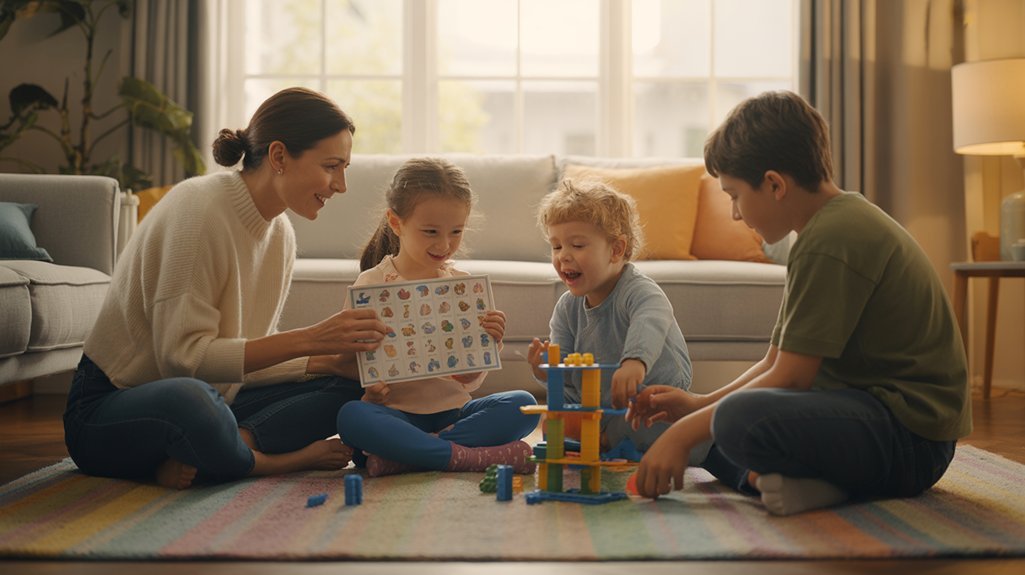
The foundation of your child's emotional resilience begins with the example you set during your own moments of stress and frustration. When you demonstrate calmness and self-control during challenging situations, you're providing a powerful template for modeling emotional regulation that your child will internalize and replicate.
Research confirms that children who observe parents practicing emotional regulation develop stronger coping mechanisms and respond more effectively to stress. You can strengthen these skills by incorporating mindfulness practices—like deep breathing or brief visualization exercises—into daily routines with your child.
Building emotional intelligence requires giving your child specific vocabulary to express feelings. When you help them articulate emotions beyond “mad” or “sad,” you're equipping them with tools for maneuvering complex situations independently.
These long-term emotional regulation skills form the cornerstone of healthier relationships and improved academic performance, as children learn to communicate effectively and manage challenges with confidence and resilience. The first three years are particularly crucial for establishing these foundational skills, as this period represents the most important time for lifelong mental health and well-being.
Connection-Based Discipline Works Better

Building these emotional regulation skills becomes considerably more effective when you prioritize your relationship with your child as the primary vehicle for teaching appropriate behavior.
Connection-based discipline alters challenging moments into opportunities for deeper understanding and growth.
When you lead with emotional connection, you'll notice remarkable shifts in your child's responsiveness:
- Your child approaches you openly after making mistakes, trusting that you'll help them understand rather than simply punish them.
- Conflicts resolve more quickly as your child feels heard and validated, eliminating power struggles that drain both of you.
- Your child internalizes values authentically because lessons emerge from trust rather than fear or compliance.
- Behavioral issues decrease naturally as your child's need for emotional security is consistently met through your responsive presence.
Research consistently demonstrates that children who experience strong emotional connection exhibit more positive behavior and cooperation.
You're not just managing behavior—you're nurturing a resilient, empathetic human being.
Addressing Parent Concerns & Doubts
You're not alone if you're questioning whether positive discipline will actually work in real-life parenting moments.
Research confirms that concerns about permissiveness, immediate results, and maintaining consistency are common—but they're based on misconceptions rather than evidence.
Understanding how positive discipline addresses these doubts will help you implement these techniques with confidence, even when facing judgment from others or unexpected behavioral escalations.
Is This Too Permissive?
How can setting limits with kindness possibly be as effective as traditional punishment? You're right to question this approach. Positive discipline strategies aren't permissive—they're structured frameworks with clear expectations that teach rather than punish. Research confirms that boundaries coexist beautifully with empathy, nurturing children's behavior through internal controls rather than external fear.
| Permissive Parenting | Positive Discipline |
|---|---|
| No clear expectations | Consistent boundaries with empathy |
| Avoids consequences | Logical consequences tied to actions |
| Child leads everything | Collaborative problem-solving |
| Inconsistent follow-through | Reliable accountability structures |
When you establish consequences directly related to actions, you're teaching accountability. Children develop problem-solving skills and emotional intelligence that punitive measures can't provide. You're not being lenient—you're being intentional about raising responsible, self-regulated individuals.
Will It Work Immediately?
Let's address the question weighing on every parent's mind: when will you actually see results? Positive discipline won't change behavior overnight. Your children need time to understand how their actions connect to consequences and to develop new patterns through empathetic communication and emotional connection.
You'll likely notice gradual improvements as your children internalize these lessons. The timeline depends on consistency—inconsistent application creates confusion and delays progress.
When you engage children in collaborative problem-solving, initial conversations may feel challenging, but research shows this approach builds lasting understanding.
Patience and perseverance are essential. While traditional punishments might appear to work faster, positive discipline creates deeper, more sustainable behavioral changes by helping children develop self-regulation skills within supportive environments that encourage genuine growth.
Handling Judgment From Others
When you choose positive discipline, you're likely to encounter raised eyebrows from grandparents, skeptical comments from other parents, and unsolicited advice about why “kids these days need firmer boundaries.”
This external pressure feels particularly intense during public moments—when your toddler melts down at the grocery store or your school-age child talks back at a family gathering.
Remember that critics often prioritize immediate behavior correction over long-term emotional development. Research validates your approach: time-outs frequently create isolation and shame, while positive discipline builds emotional intelligence and problem-solving skills.
Combat doubts by sharing your child's progress with supportive parents who understand developmental needs.
Educate others about mutual respect in parenting. Your confidence grows as you witness improved emotional regulation in your child—evidence that speaks louder than criticism.
When Behavior Escalates Anyway
Despite your best efforts with positive discipline, you'll face moments when your child's behavior spirals beyond what connection and problem-solving can immediately address. These escalations often reveal underlying needs requiring your attention through proactive parenting strategies.
| Escalation Signal | Possible Unmet Need | Your Response |
|---|---|---|
| Meltdowns at bedtime | Fatigue or overstimulation | Earlier wind-down routine |
| Aggressive outbursts | Hunger or emotional distress | Healthy snacks, emotional check-ins |
| Defiant refusals | Need for autonomy | Offer limited choices |
When children's behavior intensifies, pause and investigate rather than react. Your calm presence models emotional regulation while you actively listen and validate their feelings. This approach creates safety for expression, helping you address root causes. Maintain consistent expectations even during challenging moments, as predictability reduces anxiety and supports your child's developing self-control.
Consistency Across Different Caregivers
Your child's success with positive discipline depends greatly on whether all caregivers in their life—parents, grandparents, childcare providers, and other adults—apply similar approaches and expectations.
When caregivers maintain consistency, children develop stronger self-regulation and feel more secure, knowing what's expected regardless of who's supervising them. Inconsistent responses to behavior create confusion and may encourage boundary-testing, potentially leading to behavioral challenges.
Schedule regular conversations with everyone involved in your child's care to align on specific discipline strategies, consequences, and household rules.
Share your positive discipline philosophy and discuss how each caregiver can support these principles in their unique context. This collaborative approach doesn't require identical responses in every situation, but rather shared values and general consistency that helps your child internalize expectations and develop essential problem-solving skills.
Practical Techniques to Try
Consider these practical approaches:
- The Calming Corner: Create a cozy space with soft pillows, books, and sensory items where your child can voluntarily retreat when overwhelmed, knowing you're available for support.
- Natural Consequences: Allow children to experience direct results of their choices—forgetting lunch means feeling hungry—without adding shame or punishment.
- Active Listening Sessions: Schedule regular one-on-one time where you listen without judgment, validating feelings before discussing expectations.
- Collaborative Rule-Making: Involve children in establishing family guidelines, increasing their investment in following through with agreed-upon behaviors.
Implementing Change at Home

When you're ready to shift from traditional discipline to positive approaches, start with one or two changes rather than overhauling your entire parenting strategy overnight.
Begin by establishing clear rules that reflect your family's values, then communicate them consistently to everyone.
Schedule a regular family meeting where you'll involve your children in discussing expectations. This collaborative approach helps them feel ownership over household guidelines and strengthens their sense of responsibility.
Practice open communication by actively listening when your children share their feelings and perspectives. This builds trust and creates space for understanding rather than conflict.
Implement natural and logical consequences that connect directly to behaviors, allowing your children to learn from their experiences.
When you notice positive behavior, acknowledge it immediately through specific praise or meaningful rewards.
These evidence-based strategies create a supportive environment where children develop self-discipline and make thoughtful choices independently.
Frequently Asked Questions
What to Do Instead of Time-Out?
Instead of time-outs, you can practice emotional coaching by sitting with your child during difficult moments, helping them name and process their feelings.
Engage them in problem solving by discussing what happened and brainstorming better choices together.
You'll also want to implement natural consequences that connect their actions to outcomes, teaching responsibility through real-world experiences.
These approaches strengthen your connection while developing your child's self-regulation and critical thinking skills effectively.
What Are the Five Positive Discipline Strategies?
Ironically, discipline works best when it doesn't feel like punishment.
You'll find success with these five strategies:
- positive reinforcement to acknowledge good behavior,
- natural consequences that let children learn safely from experience,
- logical consequences directly tied to actions,
- effective communication through active listening, and
- connecting before correcting to build trust.
Research shows these developmentally appropriate approaches help children develop self-regulation while strengthening your relationship.
You're teaching life skills, not just compliance.
How to Discipline When Timeout Doesn't Work?
When timeout doesn't work, you'll find success through alternative strategies that address your child's developmental needs.
Focus on effective communication by asking what triggered the behavior and actively listening to their perspective.
Implement natural consequences that directly connect to their actions, helping them understand cause and effect.
You can also offer choices to restore their sense of control, model the calm behavior you want to see, and teach emotional regulation skills that'll serve them throughout life.
What Is the 7 7 7 Rule in Parenting?
The 7 7 7 strategy involves spending seven minutes daily in meaningful conversation with your child, creating seven weekly one-on-one opportunities, and staying fully present during interactions.
This approach strengthens effective communication and builds emotional security. Research shows parenting consistency through dedicated quality time markedly improves children's well-being and cooperation.
You'll notice your child feels more valued and understood, leading to better behavior naturally. It's about prioritizing genuine connection over punishment, nurturing the relationship that makes discipline work.
Conclusion
You're not building walls of isolation—you're constructing bridges of understanding. Each moment you choose connection over separation, you're planting seeds that'll grow into your child's emotional resilience and self-regulation. Yes, this path requires more patience than pointing to a corner, but research consistently shows it yields children who cooperate from inner motivation rather than fear. You've got the tools now. Trust the process, trust yourself, and watch your relationship—and your child's skills—flourish.
Related Articles
- The Ultimate Guide to Sibling Conflict
- The Ultimate Guide to Family Meal Planning
- The Ultimate Guide to Kids Educational Games
- 20 Fun DIY Crafts to Strengthen Family Bonds
- The Ultimate Guide to Bedtime Routine

Written by Sarah Mitchell, M.S., CFLE
Founder & Lead Editor
Sarah is a Certified Family Life Educator with a Master's degree in Human Development and Family Studies from the University of Missouri. With 15+ years of experience as a parent educator and mother of three, she brings both professional expertise and real-world parenting wisdom to every article.
Credentials: M.S. in Human Development and Family Studies, Certified Family Life Educator (CFLE)