

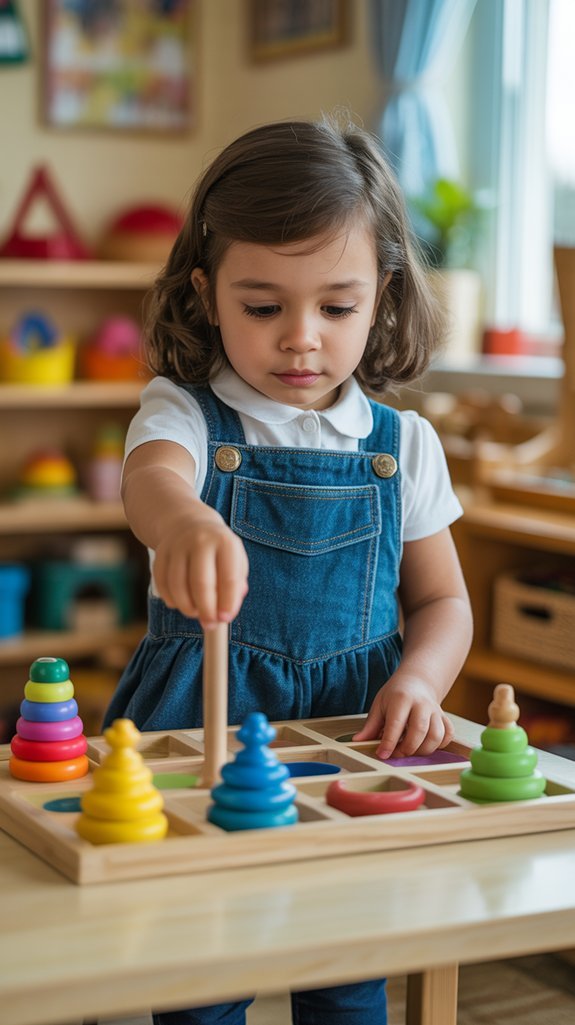

Your two-year-old builds independence through hands-on Montessori activities like pouring water from child-sized pitchers, completing knobbed puzzles, stringing large wooden beads, and matching vocabulary cards to real objects. They'll develop practical skills by helping with simple cooking tasks, setting the table with guidance from placement mats, and using child-sized cleaning tools to manage their own spills. These purposeful activities strengthen fine motor control, boost confidence, and teach responsibility while respecting your toddler's natural drive toward self-sufficiency. You'll discover specific strategies to overcome common challenges and effortlessly integrate these independence-building moments into your daily routines.
Key Takeaways
- Pouring water between containers develops fine motor skills and hand-eye coordination while building confidence through independent, repeatable practice.
- Simple puzzles with large knobs strengthen grasp, problem-solving abilities, and vocabulary recognition through familiar images and trial-and-error learning.
- Vocabulary card matching connects words to real objects, building language skills and cognitive development through concrete, hands-on exploration.
- Toddler-safe cooking tasks like washing berries or tearing lettuce build concentration, hand strength, and practical independence through meaningful work.
- Child-sized cleaning tools enable genuine participation in household tasks, developing fine motor control and responsibility through purposeful daily activities.


Montessori Busy Board for Toddlers
Best Practical Life Montessori Toys
These toys let toddlers practice real-world skills, building confidence and independence.


Best Cognitive Development Toys
Classic Montessori materials that develop hand-eye coordination and understanding of cause and effect.

Montessori Object Permanence Box
- Teaches object permanence – things exist when hidden
- Natural wood construction, non-toxic finishes
- Develops hand-eye coordination
- Classic Montessori design used in schools
Sorting & Stacking Toys
These open-ended toys develop spatial awareness, color recognition, and logical thinking.


Wooden Lacing Beads Set
- Classic Montessori fine motor activity
- Large beads safe for toddler hands
- Teaches patterns, colors, and sequencing
- Excellent value for quality wooden toy
Pouring Water From Pitcher to Cup
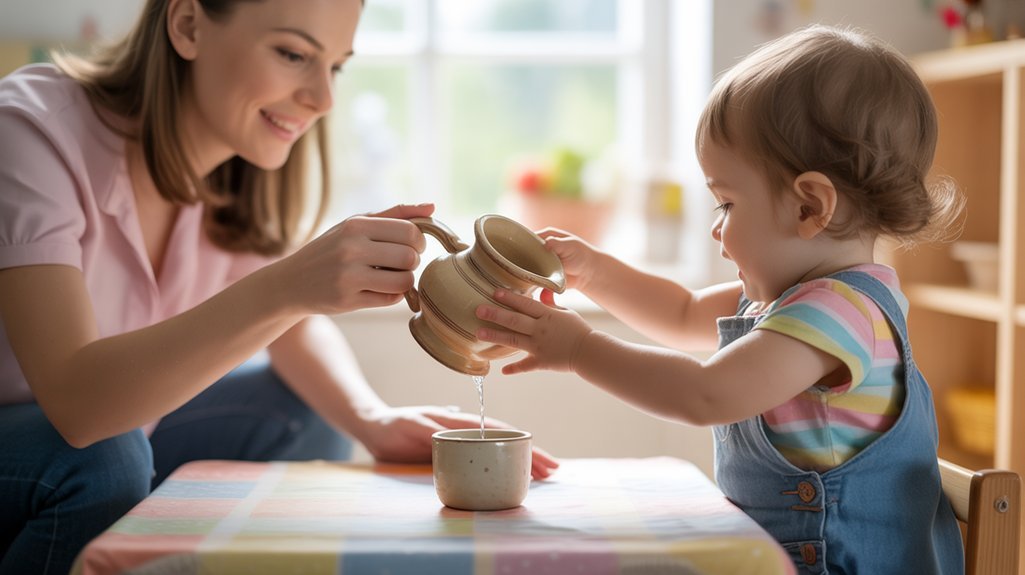
Watch a two-year-old grip a small pitcher with both hands, eyes fixed on the cup before them. This simple act builds fine motor skills and hand-eye coordination through concentrated practice. You'll notice how they adjust their pouring techniques with each attempt, learning to control the water's flow.
Set up a pouring station with a child-sized Arc jug and place a towel nearby. This setup encourages sensory exploration while teaching practical cleanup skills. Your toddler gains independence as they serve themselves, developing responsibility through real-world tasks.
The pitcher's lid prevents major spills, allowing them to take ownership without fear of failure. Each successful pour builds confidence and concentration.
Let them repeat this activity at their own pace—repetition leads to mastery.
You're not just teaching them to pour water. You're nurturing their capability to care for themselves and their environment, essential skills that serve them throughout life. These practical life skills connect to overall health by establishing foundational habits that support physical development and self-reliance.
Matching Vocabulary Cards
You'll want to start by selecting simple, high-contrast cards featuring everyday objects your toddler already encounters—a ball, cup, or banana.
Present just three cards initially, naming each object clearly as you place it before your child, then invite them to match the card to a real object in your space.
This concrete connection between image and item forms the foundation of their reading journey, training their eyes to recognize that pictures represent real things they can touch and name.
These matching activities support crucial early learning development during the most formative period when neural pathways are rapidly developing.
How to Introduce Cards
Two simple cards placed side by side become a powerful tool for your toddler's language growth. Begin with three pairs of familiar objects—items your child encounters daily like shoes, cups, or apples. Present one card at a time, naming it clearly while maintaining eye contact. Let your child hold, examine, and manipulate each card freely.
Your card selection should reflect your child's current environment and interests. Start with concrete objects before introducing abstract concepts like emotions. As confidence builds, explore game variations by adding themed sets—farm animals one week, household items the next.
Place cards face-up initially, allowing your child to study images without pressure. When they're ready, demonstrate matching one pair, then step back. This unhurried approach honors their developmental timeline while building concentration and vocabulary naturally. These vocabulary-building activities support both learning and emotional development, creating a foundation for academic success while fostering your child's natural curiosity.
Building Early Literacy Skills
As your toddler masters matching identical images, vocabulary cards open a new dimension in their learning journey. You'll notice how pairing pictures with words creates powerful language connections that strengthen both visual and verbal understanding. This vocabulary building tool invites your child to explore new concepts through repetition, naturally reinforcing retention with each matching session.
Watch as they develop fine motor skills while manipulating cards, improving hand-eye coordination through purposeful movements. The activity lays essential groundwork for literacy as your toddler begins associating spoken words with written symbols and images.
Consider introducing themed sets—animals, emotions, household objects—to spark meaningful conversations about their world. You're not simply teaching words; you're nurturing comprehension, memory, and communication skills that serve their growing independence and curiosity. These language development activities align beautifully with tracking your child's growth milestones, as vocabulary expansion represents a crucial marker of cognitive development during the toddler years.
Simple Puzzles With Large Knobs
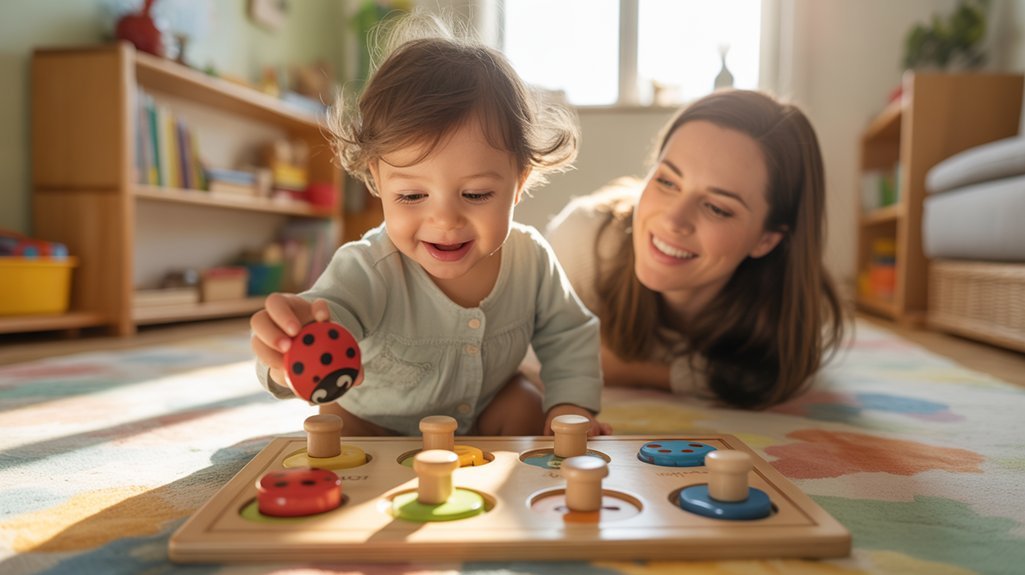
When your toddler grasps the large knob of a puzzle piece, they're engaging multiple developmental skills at once. You'll notice their fingers working to grip and manipulate each piece—this puzzle piece exploration directly strengthens motor skills development that'll serve them in countless daily tasks.
Every grasp, twist, and placement of a puzzle knob builds the fine motor strength your toddler needs for future daily skills.
These thoughtfully designed puzzles feature familiar images your child already knows: animals, shapes, everyday objects. As they match each piece to its space, they're reinforcing vocabulary and building cognitive connections between words and visuals.
Watch how your toddler approaches problem-solving. They'll test different orientations, discover what fits, and learn from what doesn't. This independent trial-and-error process teaches perseverance without adult intervention.
You're providing an activity they can repeat endlessly at their own rhythm, building concentration naturally. Each completed puzzle delivers genuine accomplishment—that visible pride on their face reveals growing confidence.
These moments of success fuel their drive toward independent play and learning.
Toddler-Safe Cooking Tasks
You'll find that your two-year-old can successfully complete meaningful cooking tasks when you offer appropriately scaled tools and clear demonstrations.
Simple preparations like washing berries, tearing lettuce, or mashing soft fruits allow your toddler to contribute to real meals while strengthening their hands and building concentration.
These kitchen moments become powerful opportunities for your child to practice sequences, refine coordination, and experience the satisfaction of purposeful work that serves the whole family.
Simple Food Preparation Ideas
Your two-year-old's growing independence finds natural expression in the kitchen, where simple food preparation tasks alter everyday routines into meaningful learning experiences.
Begin with hands-on activities like peeling bananas, stirring yogurt, or washing vegetables—each movement strengthening small muscles and building coordination.
Introduce child-safe knives for cutting soft fruits, allowing confident participation in snack preparation. Ingredient measurement offers rich learning opportunities as your toddler pours, counts, and follows recipe sequences.
Create a low shelf dedicated to snack selection, enabling autonomous choices while reinforcing nutritious eating patterns.
Cleanup becomes equally valuable when your child wipes surfaces and returns items to their places. These purposeful activities foster responsibility and environmental awareness, changing ordinary kitchen moments into foundations for lifelong capability and self-sufficiency.
Building Skills Through Cooking
As your toddler progresses from basic food preparation to more involved cooking tasks, observe how concentration deepens and capabilities expand.
Watch as peeling bananas and stirring ingredients strengthen tiny hands while building fine motor control. These repetitive cooking sequences teach coordination and encourage mastery through practice.
You'll notice your child develops genuine ownership over meals when they've participated in preparation. This connection naturally promotes positive attitudes toward toddler nutrition and food choices.
By providing child-sized tools—miniature whisks, safe spreaders, small mixing bowls—you're facilitating meaningful contribution to family routines.
Each cooking session reinforces independence skills as your toddler follows simple steps and understands cause-and-effect relationships.
They're not just cooking; they're building confidence through purposeful work that serves others while discovering their growing capabilities.
Setting and Clearing the Table
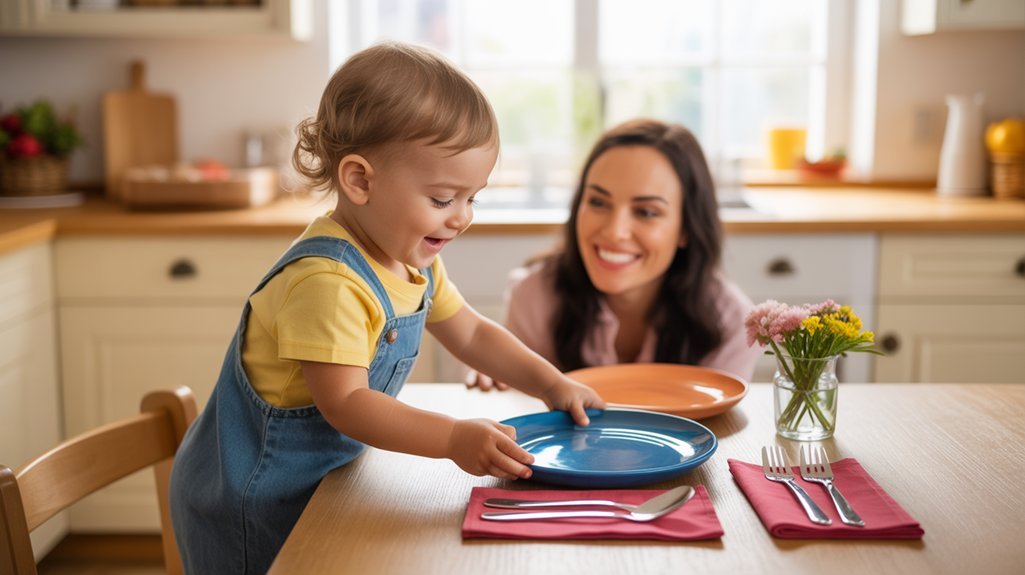
Watch a two-year-old's face light up when you invite them to help set the table for dinner. This simple task introduces table etiquette while establishing meaningful toddler responsibilities within your family routine.
Use a Montessori placemat showing proper utensil placement to guide your child. They'll learn where each item belongs while developing fine motor skills through careful manipulation of plates, cups, and silverware. As they work, they're naturally problem-solving—counting how many people need place settings and determining what items are necessary.
| Setting the Table | Clearing the Table |
|---|---|
| Count family members | Scrape plates carefully |
| Place napkins first | Stack same-sized items |
| Arrange utensils | Carry dishes with both hands |
| Set cups at top right | Wipe placemat clean |
When you allow your toddler ownership of this process, you're building their confidence and self-esteem. They're contributing meaningfully to household tasks, reinforcing their capability and independence while strengthening family connections through shared responsibility.
Color Sorting and Matching
Beyond the dining room, your two-year-old's developing skills find perfect expression in color sorting and matching activities. You'll notice how these simple tasks sharpen their color recognition while building critical thinking abilities. As your child grasps colored blocks or fabric pieces, they're refining fine motor coordination alongside cognitive development.
Different sorting techniques emerge naturally when you provide varied materials—colored trays, matching cards, or everyday objects grouped by hue. You're not just teaching colors; you're introducing descriptive vocabulary that strengthens their communication skills. “Can you find the red circle?” becomes a powerful learning moment.
Watch as your toddler gains confidence through independent choices. They'll work at their own pace, categorizing and matching without constant direction. This structured freedom helps them take ownership of their learning process.
Dressing Themselves With Practice Frames
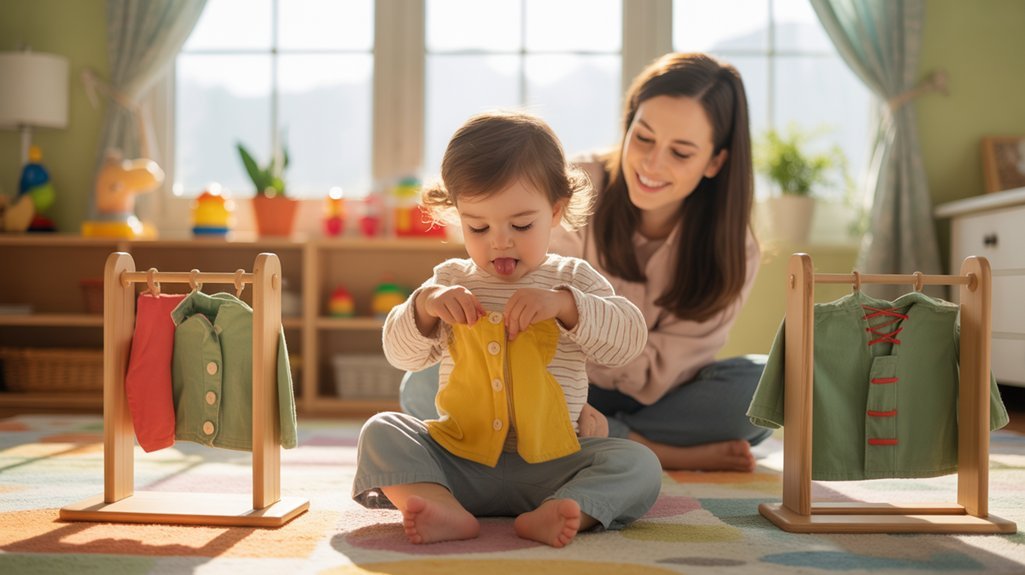
When your toddler struggles with buttons and zippers each morning, practice frames offer a purposeful solution that changes frustration into mastery. These specialized tools mirror real clothing fasteners, giving your child repeated opportunities to enhance fine motor skills through intentional practice.
Dressing frames isolate specific fastening techniques—buttoning, zipping, snapping, tying—allowing your toddler to focus without the complexity of wearing the garment. You'll notice how this concentrated practice builds muscle memory and coordination essential for independent dressing.
As your child manipulates each fastener, they're also strengthening problem-solving abilities. They determine which direction a zipper moves, how much pressure a snap requires, and the sequence needed to thread a button through fabric.
This practice nurtures genuine confidence. When your toddler successfully completes a dressing frame, they're experiencing concrete evidence of their growing capabilities. That self-assurance transfers directly to real clothing, altering morning routines from battles into opportunities for independence.
Flower Watering and Leaf Dusting
Your toddler's small watering can becomes a tool for genuine caregiving as they tip water carefully onto soil, watching droplets disappear into the earth. This simple act of plant care alters daily routines into meaningful work that builds toddler responsibility from the earliest years.
Watch as your child gently wipes dust from leaves with a soft cloth, discovering the textures and patterns of each plant. These quiet moments develop hand-eye coordination while teaching them that living things depend on consistent attention.
The concentration required to pour without spilling and dust without tearing strengthens fine motor control naturally. Through regular plant care, your two-year-old learns to observe closely—noticing when soil feels dry or leaves appear dull.
This awareness extends beyond plants, helping them understand their role in maintaining order and beauty in shared spaces. The calming rhythm of these tasks supports emotional regulation while nurturing an early connection to nature and service.
Exploring Size With Nesting Toys
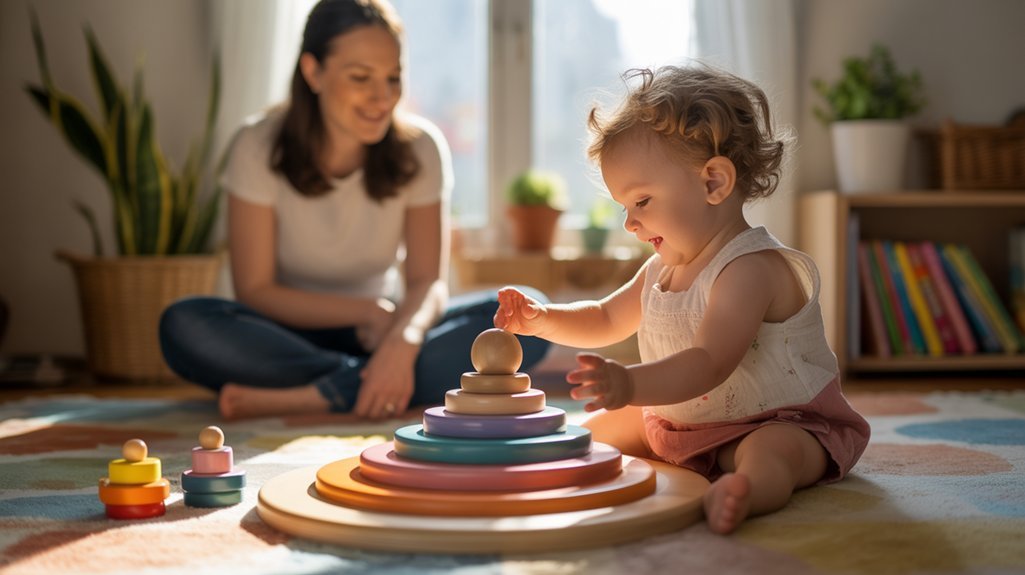
The tower of colorful cups in your toddler's hands tells a story of discovery as they test which piece slides inside another. Nesting toys alter abstract concepts into tangible experiences, allowing your child to understand size comparison through direct manipulation.
Watch as they problem-solve, determining which ring fits next or how cups stack from largest to smallest. You're witnessing spatial awareness develop with each attempt. When pieces don't fit, your toddler adjusts their approach, building critical thinking skills and independence.
This hands-on exploration strengthens fine motor control as small fingers grasp, rotate, and position each element. Enrich these moments by introducing descriptive language. Name what you observe: “You found the biggest cup” or “That small ring fits perfectly.”
Your words expand their vocabulary while validating their discoveries. These simple toys offer profound learning opportunities, equipping your child with foundational skills they'll use throughout their educational journey.
Washing Hands at a Child-Height Station
A simple basin positioned at elbow height changes an everyday task into meaningful work for your two-year-old. This child-height station includes a pitcher, soap, and small towel—everything your toddler needs to practice handwashing independently. As they pour water and lather soap, they're developing fine motor skills and hand-eye coordination while building hygiene responsibility.
| Station Component | Child's Action | Skill Developed |
|---|---|---|
| Pitcher of water | Pouring with control | Motor coordination |
| Bar of soap | Lathering and scrubbing | Self-care routine |
| Small basin | Catching dirty water | Cause and effect |
| Hand towel | Drying thoroughly | Task completion |
| Waste container | Emptying basin | Environmental care |
Your presence guarantees they learn proper handwashing techniques without wasting water. Guide them through scrubbing between fingers and rinsing completely. This daily routine modifies hygiene into a purposeful activity, nurturing both independence and responsibility in your developing child.
Sweeping and Cleaning Up Spills
You'll notice your toddler's eyes light up when you hand them a small broom—sweeping isn't just cleanup, it's purposeful movement that strengthens their coordination and autonomy.
Start by showing them how to hold the broom with both hands and use short, deliberate strokes to gather debris into one spot.
When spills happen, resist the urge to clean up immediately; instead, guide your child to their cleaning station where they can select the right tool and work through the problem themselves.
Teaching Proper Sweeping Technique
Sweeping becomes a powerful tool for independence when your 2-year-old learns to manage real spills and messes with child-sized equipment. Begin by demonstrating the back-and-forth motion, guiding their hands to gather debris into a pile before introducing the dustpan. These sweeping techniques build motor control and environmental awareness.
| Step | Action | Purpose |
|---|---|---|
| Demonstrate | Show slow, deliberate sweeping motions | Visual learning and modeling |
| Guide | Support hands during practice sweeps | Muscle memory development |
| Rotate | Alternate between broom and dustpan | Shared toddler responsibilities |
Make sweeping part of your daily routine—after snack time or outdoor play. When your child successfully cleans a spill, acknowledge their contribution to maintaining your shared space. This recognition strengthens their connection between action and environmental care.
Child-Sized Cleaning Tools
The right tools change cleaning from an adult-dominated chore into an invitation for your toddler to participate. When you provide child-sized brooms, dustpans, and cloths, you're enabling genuine contribution rather than pretend play. Your two-year-old can actually sweep crumbs or wipe spills when the tools fit their hands and height.
These appropriately scaled implements convert cleaning rituals into meaningful practice. You'll notice improved fine motor control as your child manipulates the broom or wrings a cloth.
More importantly, you're cultivating toddler responsibility through real work that matters to your household.
Watch your child's confidence grow when they successfully clean their own spill. They're learning that maintaining shared spaces isn't just adult work—it's everyone's contribution. This ownership becomes foundational to their developing independence.
Managing Spills Independently
Spills happen dozens of times during toddlerhood—and each one presents a learning opportunity rather than a crisis. You'll enable your child by offering simple spill management techniques: keep a small broom, dustpan, and cloth within their reach.
When liquid spreads across the floor, resist the urge to rush in. Instead, guide your toddler to fetch their cleaning tools and address the mess at their own pace.
This approach strengthens toddler responsibility building while developing fine motor skills and coordination. Observe as they assess the spill, determine their next steps, and work through the solution.
Offer specific praise—”You wiped up all that water”—to reinforce their capability. Through consistent practice, your child internalizes that mistakes are manageable, building self-confidence and nurturing genuine independence in their daily routines.
Beading Activities With Large Beads
Large wooden beads and a sturdy lace create an irresistible invitation for your two-year-old's developing hands. Watch as your child carefully threads each bead, building fine motor development through concentrated effort. You'll notice their focus intensify as they work to align the hole with the lace—this precise hand-eye coordination strengthens the small muscles essential for future writing and self-care tasks.
Set out beads sorted by color in small bowls, allowing your child to explore bead color combinations independently. They'll naturally begin counting and creating patterns, introducing mathematical thinking through play. The large size prevents choking hazards while reducing frustration, keeping your toddler engaged and confident.
This activity beautifully supports independence. Your child selects their own beads, works at their own rhythm, and experiences the satisfaction of completing a wearable creation. Step back and observe—they're building both skill and self-reliance with every bead they string.
Letter and Sound Games
Your two-year-old's ears are primed to distinguish the subtle sounds that form language. Letter and sound games nurture this natural ability by introducing one phonetic sound at a time, building strong foundations for letter recognition.
Sandpaper letters offer a tactile approach that engages multiple senses. As your child traces each letter's shape with their fingers, they're simultaneously hearing its sound, creating powerful neural connections that support sound association.
Alphabet puzzles provide another rich opportunity. When your child matches letters to corresponding images—”B” with a picture of a ball—they're actively linking visual symbols to sounds and meanings.
Keep these interactions brief and consistent. Five minutes of focused attention serves your child better than lengthy sessions that overwhelm.
Consider clapping syllables in familiar words. This rhythmic practice alters abstract language concepts into physical patterns your child can feel and replicate, making phonetic awareness tangible and joyful.
Preparing Simple Snacks
While language activities nourish your toddler's mind, practical life skills like preparing simple snacks address their growing desire for physical independence.
You'll notice your two-year-old's pride when they select ingredients, prepare food, and clean up afterward.
Create a designated snack station with accessible supplies at your child's height. Include simple options like bananas for peeling, crackers for spreading, or berries for washing.
This setup enables independent snack choices while you supervise nearby.
Teach kitchen safety through demonstration and practice. Show your toddler how to wash produce thoroughly, use child-safe spreaders, and carry items carefully.
These foundational skills build confidence and capability.
Guide your child through planning their snacks, helping them understand basic nutrition concepts. When they decide between apple slices or cucumber sticks, they're developing decision-making abilities.
Finally, involve them in cleanup. Wiping surfaces, placing dishes in the sink, and returning items to their spots teaches accountability and respect for their environment.
Magnetic Building Tiles
You'll find that magnetic building tiles offer your toddler a hands-on way to explore spatial relationships while strengthening their fine motor skills and problem-solving abilities.
Start by presenting just a few tiles on a flat surface, allowing your child to discover how the pieces connect through their own experimentation. As they manipulate the colorful shapes, they're naturally developing math concepts like patterns and counting alongside their growing creativity and focus.
Benefits of Magnetic Tiles
When your two-year-old picks up their first magnetic tile, you'll notice how naturally their small fingers grasp the smooth edges and discover the satisfying “click” as pieces connect. This simple action strengthens fine motor skills while building hand-eye coordination essential for future learning.
Through spatial exploration, your child learns how shapes fit together and structures balance. Watch as they experiment with towers and walls, developing problem solving abilities with each attempt. The tiles spark magnetic creativity, converting abstract ideas into tangible creations through imaginative play.
You'll find opportunities for language development naturally emerge during building sessions. Introduce words like “square,” “triangle,” “taller,” and “balance” as your child constructs.
These safe, accessible tiles enable independent exploration, allowing your toddler to build confidence alongside their colorful structures.
How to Introduce Them
Starting with just three to five tiles creates the perfect foundation for your toddler's magnetic building journey. Place them on a low shelf in a child friendly environment where your little one can access them independently.
Watch as they discover connections through creative exploration, building basic structures that make sense to their developing minds. Your role involves gentle safety supervision while respecting their need for independent play.
As they work, ask open ended questions like “What are you making?” or “How did you connect those pieces?” These conversations support cognitive development and language skills simultaneously.
Keep the space organized and calm, allowing magnetic tiles to remain an invitation for purposeful learning. This thoughtful introduction helps your toddler build confidence while developing problem-solving abilities through hands-on discovery.
Age-Appropriate Independence Activities
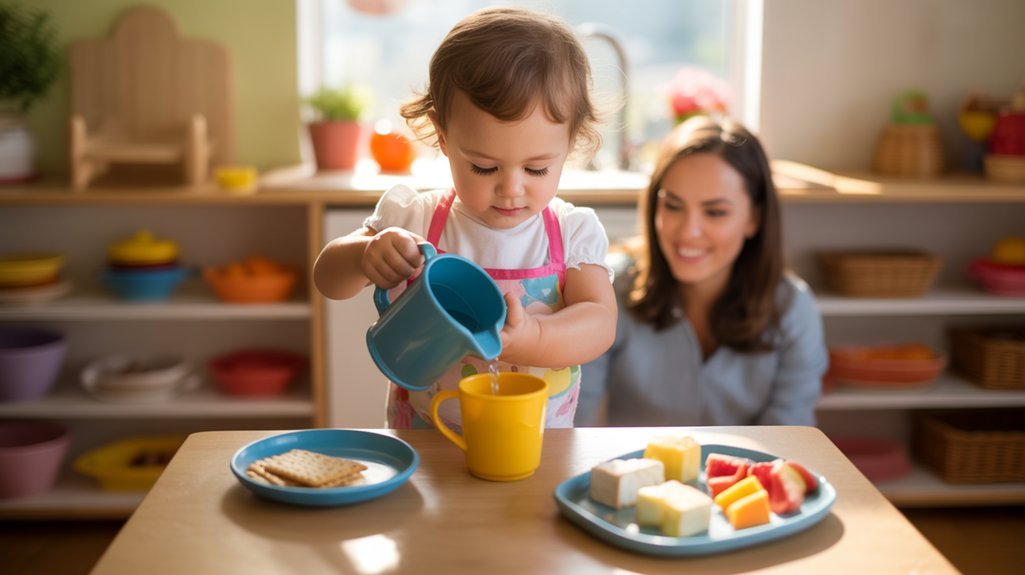
As your two-year-old reaches for the water pitcher with both hands, you're witnessing the foundation of independence taking root. These hands-on learning moments alter daily routines into significant skill development opportunities that build toddler confidence naturally.
Nurturing autonomy begins with practical tasks your child can master independently. Consider these engaging activities that encourage responsibility while supporting playful learning:
- Pouring drinks from small pitchers improves hand-eye coordination.
- Dressing themselves with simple clothing develops fine motor skills and self-reliance.
- Preparing snacks by choosing and arranging foods teaches nutritional responsibility.
- Setting the table introduces mealtime etiquette and family contributions.
Each activity offers independence benefits that extend beyond the task itself. When your toddler washes their hands without prompting or successfully buttons their jacket, you're observing more than accomplishment—you're watching confidence bloom.
These practical tasks aren't just about completing actions; they're about encouraging responsibility and enabling your child to participate meaningfully in their world.
Parents' Real-World Challenges
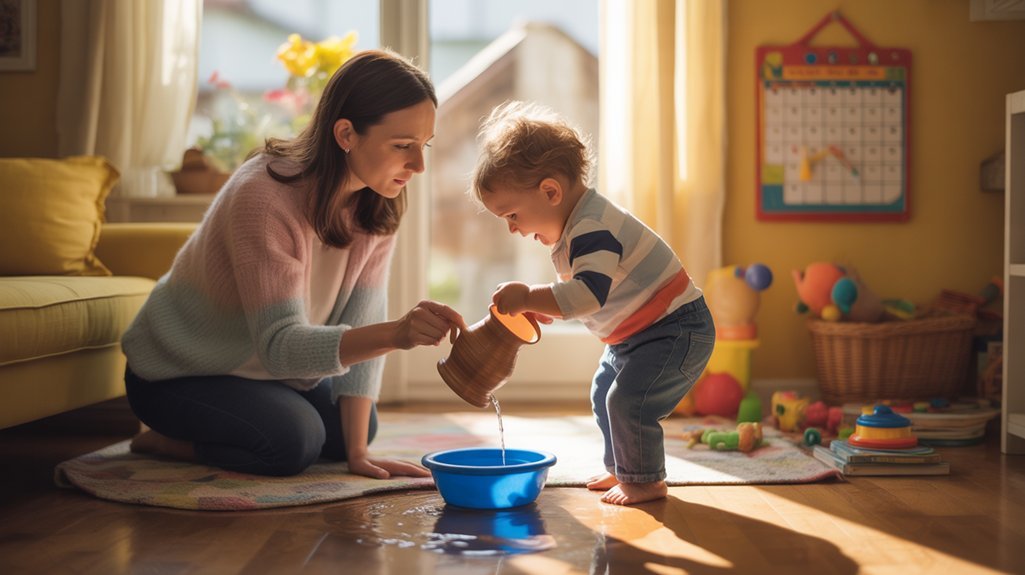
You've prepared thoughtful Montessori activities for your two-year-old, but real life doesn't always cooperate with your intentions.
Your carefully planned pouring exercise turns into a puddle on the floor just as you're rushing to leave, or your toddler refuses the independence task you've set up, demanding you do it instead.
These everyday challenges—from cramped living spaces to safety concerns—can make you question whether encouraging independence is worth the extra effort.
Time Constraints and Busy Schedules
When your calendar overflows with work deadlines, household responsibilities, and family commitments, finding time for deliberate Montessori activities can feel impossible.
However, effective time management doesn't require hours of dedicated practice sessions. You can weave independence-building moments into existing family routines by inviting your two-year-old to participate in everyday tasks.
Those ten minutes during meal prep become opportunities for your child to wash vegetables or tear lettuce. Clean-up time changes into purposeful work as they wipe their table or sort laundry. These brief, focused interactions build confidence and problem-solving abilities more effectively than elaborate setups.
Consider utilizing pre-prepared materials or community resources that eliminate extensive planning. Your structured daily routine already contains countless teachable moments—you simply need to recognize and embrace them.
Messy Activities and Cleanup
While water play and sensory bins promise developmental benefits, the puddles spreading across your kitchen floor and paint-stained clothing tell a different story about daily implementation. Alter these messy play challenges into opportunities for toddler responsibility by establishing clear cleanup routines.
| Setup Strategy | Cleanup Approach |
|---|---|
| Waterproof mats under sensory exploration areas | Child-sized brooms for spill management |
| Designated messy play zones | Small spray bottles with water cloths |
| Smocks or old clothing | Handwashing stations at child height |
| Containable materials in trays | Cleanup songs for engaging activities |
Child encouragement begins when you provide accessible cleaning tools. Your two-year-old develops independence by participating in fun cleanup immediately after activities. This purposeful approach teaches natural consequences while maintaining your enthusiasm for enriching sensory experiences that genuinely support development.
Limited Space at Home
Your small apartment doesn't need to limit your toddler's Montessori journey. Space optimization begins with child-sized furniture that enables your two-year-old to access materials independently.
Smart furniture selection matters—choose storage benches and foldable tables that serve multiple purposes while supporting practical life activities.
Vertical storage alters your environment. Wall-mounted shelves and hooks free valuable floor space, giving your toddler room to move and explore confidently.
Create designated areas for specific activities: a small cooking corner, a cozy reading nook, or a dressing station. These focused spaces help your child concentrate without feeling overwhelmed.
Implement a toy rotation system to maintain order and purpose. By offering just a few carefully selected materials at a time, you'll encourage deeper engagement and genuine independence in your toddler's daily activities.
Resistance From Strong-Willed Toddlers
Strong-willed toddlers don't resist Montessori activities because they're defiant—they're asserting their developing independence. When you encounter toddler resistance, recognize it as healthy development rather than opposition.
Effective independence strategies include offering bounded choices and maintaining consistent routines that provide security. You'll find success when you celebrate small achievements through positive reinforcement, altering resistance into engagement.
| Challenge | Independence Strategies | Expected Outcome |
|---|---|---|
| Refuses activity | Offer two activity choices | Child selects preferred option |
| Resists changes | Establish predictable routines | Reduces anxiety, increases cooperation |
| Demands control | Allow simple decisions (outfit/snack) | Builds autonomy, decreases pushback |
Your calm, patient responses model emotional regulation. When you stay composed during challenging moments, you're teaching your toddler to manage their feelings while respecting their natural drive toward independence.
Balancing Independence With Safety
Because toddlers lack the developmental capacity to recognize danger, you'll need to engineer their environment before granting freedom to explore.
Install age appropriate tools and child-sized furniture that promote independent exploration while removing hazardous items from reach.
Effective toddler supervision means watching closely during activities requiring fine motor precision—cutting, pouring, transferring. Your presence enables safe exploration without constant intervention.
Establish clear safety guidelines for each real life task you introduce. When your child participates in routine participation like table setting or snack preparation, define specific boundaries: “You carry the napkins, I'll carry the plates.”
Gradual independence encouragement works best. Start with simple activities, observe your child's skill development, then slowly expand their responsibilities.
This boundary setting approach balances capability with protection, allowing your toddler to build competence within safe parameters you've thoughtfully created.
Troubleshooting Common Implementation Obstacles
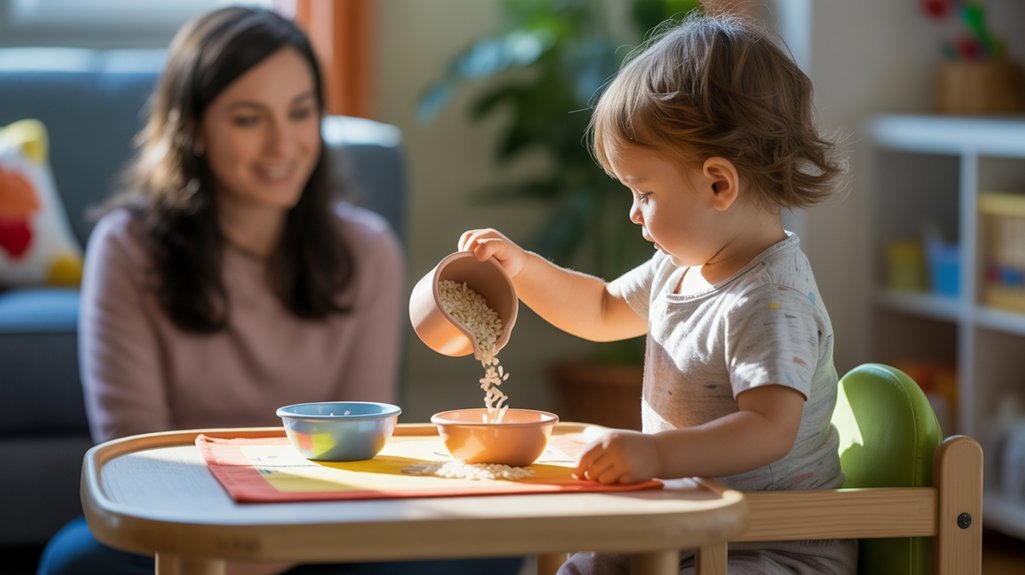
When resistance surfaces during Montessori activities, it's often a signal that something in the environment or approach needs adjustment rather than a reflection of your child's abilities. Overcoming resistance begins with observing what's hindering progress and encouraging exploration through thoughtful modifications.
Resistance signals environmental mismatch, not inability. Observe obstacles, then thoughtfully modify the approach to restore natural exploration.
Consider these practical adjustments:
- Scale back complexity – Introduce one activity at a time, allowing mastery before adding new challenges.
- Ensure proper sizing – Provide child-sized tools that make participation physically achievable.
- Step back intentionally – Resist over-assisting, which diminishes their natural drive to learn through hands-on experience.
- Strengthen routine predictability – Set clear expectations with gentle reminders during changes.
Celebrate each small achievement to reinforce their efforts and build confidence.
When your child struggles, pause to assess whether the environment supports their capabilities. Patience alters obstacles into learning opportunities, creating a foundation where independence flourishes naturally.
Your role is guiding without controlling, observing without hovering.
Starting Your Independence Journey
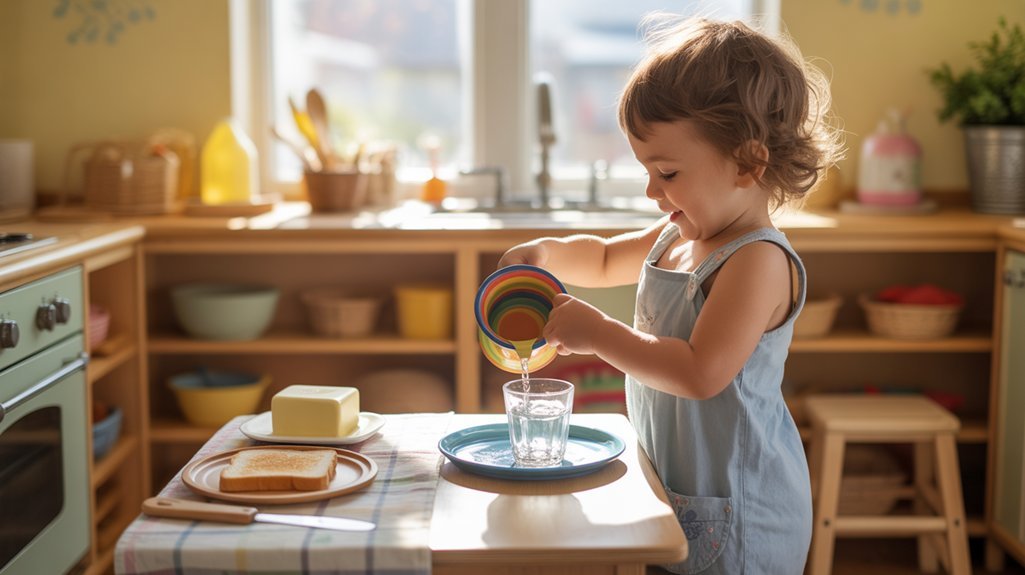
Your child's independence journey begins with carefully prepared spaces that invite participation rather than passive observation.
Alter your home by placing child-sized furniture, accessible tools, and materials at your toddler's eye level. This environmental shift enables your two-year-old to engage meaningfully with daily routines.
Focus on practical life activities that match your child's developing capabilities. Offer simple choices between two outfits to strengthen toddler decision making and build confidence.
Introduce tasks like pouring water from a small pitcher or spreading butter on toast—activities that refine fine motor skills while establishing responsibility.
Track independence milestones without pressure or comparison. Your toddler will master skills at their own pace when supported by consistent routines and gentle guidance.
Watch as they discover the joy of “I did it myself!” Each successful attempt, whether perfect or messy, reinforces self-reliance and builds the foundation for lifelong learning.
Your patient observation and thoughtful preparation make this growth possible.
Frequently Asked Questions
How Do I Balance Independence Activities With Necessary Safety Supervision?
Research shows 2-year-olds thrive with 80% independent exploration when properly supervised.
You'll find the independence balance by creating prepared environments where children safely explore within your watchful presence. Position yourself nearby, observing without hovering, ready to guide only when needed.
Follow clear safety guidelines: remove hazards, use child-sized materials, and establish boundaries.
You're not controlling their experience—you're protecting their freedom to discover. This purposeful supervision honors their capabilities while ensuring their well-being as they develop essential life skills.
What if My Child Refuses to Participate in Independence Activities?
Respect your child's refusal without pressure. Observe what genuinely interests them—that's where child motivation naturally emerges.
Model the activity yourself nearby, making it look enjoyable rather than mandatory. Use playful encouragement through songs, gentle invitations, or working alongside them.
Sometimes children need time to watch before participating. Remember, nurturing independence isn't about forcing tasks; it's about creating an environment where they'll eventually choose to engage when they're developmentally ready and curious.
How Long Should Each Montessori Activity Session Last for Toddlers?
Don't watch the clock—watch your child. Activity duration for toddlers naturally ranges from 5-15 minutes, though some children will surprise you with longer engagement.
Toddler attention spans bloom differently for each child, so you'll want to follow their lead rather than imposing rigid timeframes. Notice when they're deeply focused versus when restlessness appears.
If you're attuned to their cues, you'll discover their natural rhythm and support authentic independence through responsive, child-led pacing.
Can Montessori Independence Activities Work in Small Apartment Spaces?
Yes, you'll find independence activities thrive in compact homes through thoughtful space organization.
Watch your toddler access low shelves with just 3-4 activities rotated regularly. You can support their development through activity adaptation—folding laundry on a coffee table, washing vegetables in a small basin, or dressing themselves in a corner nook.
Your child doesn't need sprawling rooms; they need purposeful spaces where they can reach, choose, and complete meaningful work independently.
When Should I Intervene if My Child Struggles With Tasks?
You'll notice intervention strategies work best when you wait—observe first before stepping in.
Watch for genuine frustration versus productive struggle; there's a meaningful difference. You're encouraging resilience when you allow your child to work through challenges independently.
Intervene only when they're truly stuck or unsafe, not merely uncomfortable. Offer minimal help: “Would you like me to hold this while you try?”
This approach respects their capability while providing support, nurturing the independence and confidence they're naturally developing through purposeful practice.
Conclusion
You've planted the seeds—now watch your toddler blossom into a capable, confident little person. Each pitcher they pour, each puzzle they complete, strengthens their growing independence. You'll notice their pride when they set the table or help prepare snacks. Don't worry if things get messy or take longer; that's exactly how real learning happens. Start with one activity today. Observe what captures their interest, then build from there. Your child's ready.
Related Articles
- The Ultimate Guide to Sibling Conflict
- The Ultimate Guide to Family Meal Planning
- The Ultimate Guide to Kids Educational Games
- 20 Fun DIY Crafts to Strengthen Family Bonds
- The Ultimate Guide to Screen Time Management

Written by Sarah Mitchell, M.S., CFLE
Founder & Lead Editor
Sarah is a Certified Family Life Educator with a Master's degree in Human Development and Family Studies from the University of Missouri. With 15+ years of experience as a parent educator and mother of three, she brings both professional expertise and real-world parenting wisdom to every article.
Credentials: M.S. in Human Development and Family Studies, Certified Family Life Educator (CFLE)