



You'll change homework time by creating a distraction-free study zone and establishing a consistent daily routine. Break large projects into smaller, manageable chunks your child can tackle confidently. Schedule 20 minutes of physical activity before homework to boost concentration, then stay connected with teachers through regular check-ins. Focus on celebrating small victories—whether with stickers or simple praise—to build your child's confidence. When you combine these established methods with choice-based assignments and quality-over-quantity thinking, you'll discover even more ways to support your elementary student's success.
Key Takeaways
- Create a distraction-free homework zone with necessary supplies and establish a consistent daily routine with specific study times.
- Break large assignments into smaller, manageable tasks with deadlines to prevent overwhelm and last-minute panic.
- Incorporate 20 minutes of physical activity before homework to boost energy, memory retention, and concentration.
- Make homework relevant by connecting assignments to real-life applications, student interests, and future career aspirations.
- Offer assignment choices across traditional, creative, and interactive formats to increase student motivation and engagement.
Set Up a Distraction-Free Homework Zone

Creating a dedicated homework space can change your child's study habits from chaotic to productive. You'll want to choose a quiet, well-lit corner where your student can focus without interruptions.

Stock this area with pencils, paper, and textbooks so everything's within reach—no more hunting for supplies mid-assignment.
Make the space inviting by adding your child's favorite colors or decorations. When students understand they've their own special zone, they're more motivated to tackle assignments.
Eliminate distractions by turning off the TV, silencing phones, and clearing away clutter that pulls attention from the task at hand.
Your homework help becomes more effective when the environment supports concentration. Check in regularly to see what's working and what isn't.
Maybe the lighting needs adjustment, or perhaps the chair's uncomfortable. Small tweaks make big differences.
Research shows that early childhood development during the first years of life significantly impacts learning habits and academic success throughout elementary school.
Establish a Consistent Daily Routine
When you set a regular homework time each day, your child learns exactly what to expect and builds lasting study habits. Choose a specific time—ideally between after-school and dinner—to help students maintain focus and make homework feel predictable rather than stressful.
A consistent daily routine creates security and teaches responsibility. Your child will naturally prepare for this dedicated study time, developing strong time management skills that extend beyond elementary school.
Remember to build in time to take a break during longer homework sessions. These short pauses refresh concentration and prevent overwhelm, making the routine sustainable and effective.
Short breaks during homework refresh your child's focus and prevent burnout, making study time more effective and sustainable.
Stay flexible within your structure. If your child has heavier assignments on certain days or learns differently than peers, adjust accordingly. The goal isn't rigid scheduling—it's creating a dependable framework that supports your student's unique needs.
When you establish this rhythm, you're giving your child tools for academic success that'll serve them for years. Just as parents track their baby's progress through important developmental milestones in the first year, monitoring your elementary student's homework habits helps you recognize their academic growth and adjust support as needed.
Break Large Assignments Into Manageable Chunks

Large projects can feel like mountains to young students, but you can help change that intimidation into confidence by teaching your child to divide assignments into smaller, actionable steps.
Start by creating a simple timeline together, setting specific deadlines for each portion of the homework. This structured approach builds valuable time management skills that'll serve them throughout their school days.
Encourage your child to prioritize sections based on difficulty or interest, giving them ownership over their learning process. Schedule regular time blocks for completing each chunk, which prevents last-minute panic and creates a balanced workload.
Here's the rewarding part: celebrate each completed section with a short break or small treat. These mini-victories help students associate homework completion with positive feelings rather than dread.
When children see large assignments as conquerable challenges rather than overwhelming obstacles, they'll develop confidence that extends far beyond individual projects.
Incorporate Physical Activity Before Study Time
Before your child sits down to tackle homework, send them outside for a quick bike ride or dance session—their brain will thank you for it.
Right after school, children often need to release pent-up energy before they can focus effectively. Twenty minutes of physical activity—whether it's running, jumping jacks, or free play—boosts memory retention and sharpens concentration.
Exercise releases endorphins that reduce stress and anxiety, helping your child approach assignments with a calmer, more positive mindset.
You'll notice improved academic performance when physical activity becomes part of your homework routine. Consider offering a healthy snack after their active break to refuel their body and brain.
During longer homework sessions, encourage brief movement breaks to reset their focus and increase productivity.
This simple strategy helps establish a positive association with study time, converting homework from a dreaded chore into a manageable task.
You're setting your child up for both academic success and lifelong healthy habits. Regular physical activity is also essential for overall health and helps children thrive by overcoming obstacles that might otherwise interfere with their learning potential.
Stay Connected With Your Child's Teachers

While establishing strong home routines supports your child's learning, partnering with their teacher creates an even more powerful foundation for academic success. Attend parent-teacher conferences and school events to build rapport and understand classroom expectations. When you connect with teachers regularly, you become an effective role model for collaboration and communication.
Find a time to check in about assignments, teaching methods, and your child's progress. This partnership helps you reinforce school lessons at home while maintaining appropriate involvement levels. Remember that staying balanced and present as a parent while navigating these educational partnerships models healthy behaviors for your child.
| Connection Method | Purpose | Frequency |
|---|---|---|
| Parent-teacher conferences | Discuss homework policies and academic progress | Quarterly or as scheduled |
| Email check-ins | Clarify assignments and due dates | Weekly or as needed |
| School events | Build relationships and understand classroom interactions | Monthly when available |
| Open communication channels | Address concerns and align support strategies | Ongoing basis |
This collaborative approach guarantees you're supporting your child's learning journey effectively.
Encourage Independent Problem-Solving
When your child encounters a challenging homework problem, resist the urge to immediately provide the answer. Instead, guide them to review their class notes and textbooks first. This approach builds confidence and reinforces what they've learned in elementary school.
Make sure your kitchen table becomes a space where mistakes are celebrated as learning opportunities. When children struggle, ask guiding questions: “What have you tried so far?” or “Can you break this into smaller steps?” This helps them develop critical thinking skills they'll use throughout their education.
Encourage your child to identify exactly where they're stuck, then teach them to ask specific questions. This skill prepares them to seek help from teachers and classmates appropriately.
Make Homework Meaningful and Engaging

You'll see greater engagement when homework focuses on meaningful practice rather than busywork—assign fewer, well-chosen problems that directly reinforce classroom learning.
Give your students choices in how they complete assignments, whether through written work, drawings, videos, or other creative formats that match their strengths and interests.
Connect tasks to real-world situations they care about, making the learning relevant to their daily lives and helping them understand why the practice matters.
Quality Over Quantity Matters
Because homework time is precious and limited, you'll want to guarantee every assignment counts. Research shows students spend less time on homework than teachers expect, making focused assignments essential. Instead of overwhelming children with repetitive worksheets, select fewer, targeted problems that directly connect to classroom learning.
Give students homework ownership by letting them choose from curated options. This autonomy increases motivation and changes assignments from obligations into opportunities. When children feel invested in their work, meaningful engagement naturally follows.
Consider diverse formats like creative projects or multimedia presentations that allow varied expression. Grade based on completion rather than accuracy to reduce anxiety and encourage risk-taking.
Offer Choice and Variety
Students thrive when they're given meaningful choices in their homework assignments. By honoring homework preferences and providing student autonomy, you'll encourage deeper engagement and ownership. Offer diverse formats that match different learning styles—visual projects, creative writing, or presentations all help students demonstrate understanding uniquely.
Consider presenting options like these:
| Traditional Format | Creative Format | Interactive Format |
|---|---|---|
| Written responses | Illustrated posters | Teaching a family member |
| Practice worksheets | Comic strip explanations | Video demonstrations |
| Reading summaries | Song or poem creation | Hands-on experiments |
| Math problem sets | Building models | Digital presentations |
When students select assignments that spark their curiosity, they're more likely to complete work and retain concepts. Include voluntary enrichment tasks for those wanting extra challenges, reshaping homework from obligation into opportunity.
Connect to Real Life
When homework mirrors the world beyond the classroom, elementary students discover why their learning matters. You'll strengthen engagement by designing assignments that demonstrate real world applications—connecting math problems to grocery shopping or writing tasks to community issues students actually care about.
Build community connections by incorporating local resources into homework. Encourage visits to museums, nature centers, or neighborhood landmarks that enrich their understanding. These experiences cultivate independent exploration while making learning tangible.
Link assignments to students' future aspirations. When children see how today's homework prepares them for tomorrow's dreams, motivation soars. Ask them to interview professionals, research careers, or solve problems related to their goals.
This student-centered approach alters homework from obligation into opportunity, showing young learners they're developing skills that genuinely matter.
Monitor Progress Without Micromanaging

Finding the right balance between staying informed and giving your child space to work independently stands as one of the most valuable skills you'll develop as a parent.
Regular check-ins about assignments keep you aware without hovering over their shoulder.
Progress tracking tools like planners and calendars enable your child to manage deadlines independently.
You're teaching essential time management skills while respecting their autonomy.
Schedule weekly homework reflection sessions where your child shares their academic goals and challenges.
These conversations create safe spaces for honest dialogue without feeling controlling.
Student accountability strategies, such as checklists and rubrics, help children evaluate their own work.
They'll develop critical self-assessment skills that serve them throughout their education.
Celebrate small wins and improvements in homework completion.
Your recognition reinforces positive habits without dictating their approach.
You're supporting their growth while trusting them to take ownership of their learning journey.
Quick Wins Parents Need
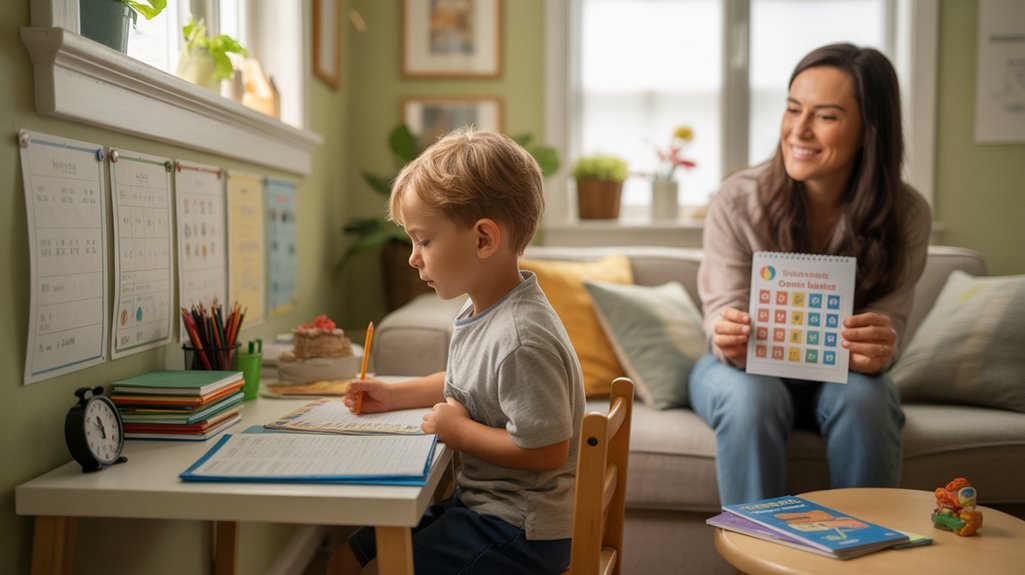
Small changes create massive shifts in your child's homework success. You don't need elaborate systems—just strategic moves that deliver immediate results.
Start with these proven motivation boosts that work:
- Set up a clutter-free zone where your child studies consistently, reducing decision fatigue and sharpening focus.
- Implement 5-minute breaks between assignments to refresh their brain and maintain peak performance.
- Break big projects into bite-sized chunks so overwhelming tasks become achievable stepping stones.
- Create simple homework rewards like extra playtime or choosing dinner, celebrating effort rather than perfection.
These study techniques aren't complicated, but they're life-changing. You'll notice improved concentration within days, not weeks.
The key is consistency—your child thrives when they know what to expect. By honoring their need for structure while building in flexibility, you're teaching invaluable life skills.
Watch their confidence soar as homework evolves from battleground to opportunity.
Addressing Homework Challenges Head-On

You'll face real homework battles—kids who won't start, tears over tough problems, and assignments that pile up across subjects.
These challenges don't mean you're failing as a parent; they're normal parts of your child's learning journey.
Let's tackle each obstacle with practical strategies that build your child's confidence and independence while keeping homework time productive.
When Kids Resist Starting
When your child suddenly needs a snack, remembers an urgent toy emergency, or develops a mysterious stomach ache the moment homework time arrives, you're witnessing classic avoidance tactics.
These homework motivation techniques can help: establish a predictable routine so your child anticipates study time rather than dreading it. Set up a distraction-free workspace stocked with supplies, removing common excuses.
Before diving in, encourage ten minutes of physical activity—jumping jacks or a quick walk—to boost their mood and concentration. Breaking assignments into smaller chunks with built-in breaks prevents overwhelm while overcoming procrastination barriers.
Most importantly, celebrate their effort, not just perfection. This positive reinforcement works wonders for nurturing positive attitudes, converting resistance into willingness as children recognize their growing capabilities.
Managing Time and Distractions
Between school, activities, and play, your elementary student's schedule fills up quickly—and homework can feel like just another battle for their attention. You can help by establishing a consistent homework routine that builds time awareness naturally.
Create a quiet, well-lit workspace free from television, phones, and other distractions—this simple change dramatically improves focus.
Teach your child distraction management by having them track how long assignments actually take. This awareness helps them recognize when they're struggling and need support.
Incorporate productivity techniques like short breaks every 20-30 minutes to prevent burnout and maintain concentration.
Handling Frustration and Tears
Every parent has witnessed it: the crumpled worksheet, the quivering lip, the tears spilling over math problems that seem impossible to solve. Homework anxiety is real, but you can change these moments into resilience building opportunities through intentional emotional support.
| When Your Child Shows | Try This Response |
|---|---|
| Tears and shutdown | Guide deep breathing: “Let's take three slow breaths together” |
| “I can't do this!” | Ask questions: “What part makes sense? Where does it get tricky?” |
| Repeated struggle | Contact the teacher to discuss modifications |
| Small progress | Celebrate immediately: “You figured that out!” |
Validate their feelings without rescuing them from the challenge. Short breaks help reset overwhelmed minds. Your steady presence teaches children that struggle doesn't equal failure—it's part of learning.
Dealing With Incomplete Assignments
Sometimes the tears aren't about frustration with hard problems—they're about assignments that never got finished at all. Start by communicating with teachers to understand what's blocking completion. You'll discover whether it's difficulty, distraction, or feeling overwhelmed.
Help your child break large assignments into smaller tasks, making progress feel achievable. Create a distraction-free homework space and establish consistent check-in times to monitor progress. This parental support shows you're invested in their success.
Encourage assignment reflection by discussing what prevented completion without judgment. Promote peer collaboration when appropriate—sometimes studying with classmates provides motivation.
Most importantly, frame incomplete work as learning opportunities rather than failures. You're teaching your child that setbacks are stepping stones toward improvement, building resilience that extends far beyond homework.
Balancing Multiple Subjects Daily
When your child juggles math worksheets, spelling lists, and science projects all in one evening, the mental load can feel crushing. You'll enable them through subject prioritization strategies that tackle the hardest assignments first when energy peaks.
Create a consistent homework schedule with dedicated time slots for each subject, making homework workload management tangible rather than overwhelming.
Help your child break large projects into bite-sized chunks through effective task delegation across multiple days. Visual planners convert abstract deadlines into concrete action steps, building essential organizational skills.
Review completed work together to reinforce learning and spot knowledge gaps across subjects.
Don't hesitate to contact teachers when challenges arise. Your communication guarantees your child receives the support they need to flourish academically across all subjects.
Proven Teacher-Tested Techniques

As elementary teachers refine their classroom practices year after year, they've discovered that establishing a homework routine during the first weeks of school creates a foundation for success that lasts the entire year.
You'll find these homework collaboration strategies change how students approach their assignments while building essential peer support systems.
Teacher-Tested Techniques That Work:
- Assign homework buddies to check completion before class begins, creating natural accountability.
- Grade on completion, not perfection to reduce anxiety and encourage risk-taking.
- Use small group instruction to address common homework struggles during class time.
- Introduce creative assignment formats like visual projects, audio recordings, or hands-on activities.
These approaches shift homework from a source of stress to a learning opportunity.
When you focus on progress rather than perfection, students develop confidence in their abilities.
Celebrating Small Homework Victories

Beyond implementing effective homework strategies, the real magic happens when you acknowledge each step forward your students take. Celebrating achievements, no matter how small, changes homework from a dreaded task into an opportunity for growth.
You'll find that rewarding efforts with simple recognition—like stickers, verbal praise, or high-fives—creates powerful momentum. When children see their progress on a visual chart tracking completed assignments, they develop genuine pride in their work. This tangible reminder reinforces that consistent effort matters.
Fostering motivation extends beyond the classroom. Encourage families to share homework victories during dinner conversations, creating a supportive circle that values academic dedication.
These celebrations don't need to be elaborate; authenticity matters most.
Frequently Asked Questions
What Is the 10 Minute Rule for Homework?
The 10 Minute Rule guides homework duration by multiplying a student's grade level by ten minutes—so your second grader gets 20 minutes nightly.
This practical approach supports effective time management while maintaining student engagement without causing burnout.
You'll find it helps create a healthy balance between learning and family time.
What Type of Homework Is Most Effective?
You'll find that engaging assignments connected to real-world experiences work best for elementary students.
When you offer varied formats—like drawings, videos, or hands-on projects—you're meeting different learning styles.
Collaborative projects especially shine because they let students learn together while building social skills.
The key? Give your students choices that spark their curiosity and relate directly to classroom lessons.
This approach changes homework from a chore into meaningful practice they'll actually want to complete.
What Is an Effective Way for Children With ADHD to Prioritize Their Homework?
You can help your child with ADHD prioritize homework by using effective ADHD strategies that make a real difference.
Start with task breakdown—divide assignments into smaller, doable steps. Then introduce visual aids like color-coded planners or charts showing due dates and importance levels.
This combination helps your child see what's urgent versus what can wait. You'll enable them to tackle homework confidently while building essential organizational skills they'll use throughout their academic journey.
What Is the Most Effective Way to Do Homework?
Picture your child's face lighting up as they confidently complete assignments—that's achievable!
You'll nurture success by implementing homework motivation techniques like breaking tasks into bite-sized chunks and celebrating small wins.
Develop their time management skills through consistent routines and visual timers.
Your parental involvement strategies matter most: sit nearby modeling focus, offer encouraging guidance without hovering, and incorporate revitalizing breaks.
You're enabling them to become independent, capable learners who'll thrive academically.
Conclusion
You've probably heard that homework is just about discipline and sitting still—but here's the truth: it's actually about building confidence through small, consistent wins. When you create the right environment, break tasks down, and celebrate progress, you're not just helping your child finish assignments. You're teaching them they're capable of tackling challenges independently. That belief? It'll carry them far beyond elementary school. Start with one strategy today.
Related Articles
- The Ultimate Guide to Sibling Conflict
- The Ultimate Guide to Family Meal Planning
- The Ultimate Guide to Kids Educational Games
- 20 Fun DIY Crafts to Strengthen Family Bonds
- The Ultimate Guide to Screen Time Management

Written by Sarah Mitchell, M.S., CFLE
Founder & Lead Editor
Sarah is a Certified Family Life Educator with a Master's degree in Human Development and Family Studies from the University of Missouri. With 15+ years of experience as a parent educator and mother of three, she brings both professional expertise and real-world parenting wisdom to every article.
Credentials: M.S. in Human Development and Family Studies, Certified Family Life Educator (CFLE)