


Here's the thing about family goal setting: most of us never actually do it. We might jot down New Year's resolutions or have vague hopes for the year ahead, but we don't sit down as a family and talk about what we actually want to build together. I realized this about three years ago when my 8-year-old asked me, “Mom, what are we working toward?” and I couldn't give her a clear answer. That question changed everything. The research backs this up—families that set intentional goals together show measurable improvements in communication, motivation, and follow-through. But here's where most goal-setting advice falls apart: it's either too rigid (rigid plans backfire when life happens) or too vague (we've all abandoned a goal by February). This article walks you through activities that work because they're rooted in how families actually operate—messy, busy, real families with competing priorities and different ages. You'll find specific activities designed for different age groups, exact materials lists with budget alternatives, honest stories about what didn't work, and templates you can use today. The goal isn't perfection; it's creating a family culture where you know what matters and you move toward it together.
Why Goal Setting Works Differently in Families
Individual goal setting assumes one brain, one priority list, and one source of motivation. Family goal setting is exponentially more complex. You've got a 5-year-old who wants to learn to ride a bike, a teenager focused on grades, parents juggling work deadlines, and maybe a toddler who just wants snacks. When these motivations live in the same household without connection, you get chaos. More importantly, you miss the compounding effect of shared purpose.


Studies from the University of Minnesota show that when families articulate shared values and goals, children report higher self-esteem and parents experience less conflict around daily decisions. That's not because the goals themselves are magical—it's because once your family agrees on what matters, the small daily choices become easier. When you've said, “This year we're prioritizing time together,” it's easier to say no to an extra work meeting. When your kids know the family is working toward “read more books together,” they stop complaining about the bedtime story routine.
The catch is that family goals only work if every person feels some ownership. A goal the parents impose falls apart within weeks. The kids need to feel heard. Younger children need to understand it in simple terms. Teenagers need to see how it affects their actual lives, not just family culture. That's why the activities in this guide build in voice and choice—they're not lectures. They're conversations where people actually listen.
The Family Goal-Setting Session Activity (Ages 5+)
This is the foundational activity. It takes one 90-minute session once a year, ideally in September or early January, though honestly any weekend works. The session produces a one-page family goals document that stays visible in your home (more on that later). Most families I've worked with do this once yearly, then check in quarterly with a 30-minute refresh.
Here's what you need: large poster board or flip chart paper (one sheet costs $3–$5 at Dollar Tree or Michaels), markers in multiple colors (Crayola classic pack, $4 for 24 colors), printed templates (free download from Family Flourish), sticky notes (99-cent pack), and snacks—this matters more than you'd think. Kids focus better with a small snack nearby. Budget total: $12–$18 depending on what you already own. For a screen-free alternative, use a large roll of butcher paper ($2 at restaurant supply stores) and go digital-free.
Here's how the session flows: Start with a 10-minute individual reflection. Each person writes or draws three things they'd like to be better at this year. These are personal goals—they don't have to be family-related yet. A 6-year-old might draw “read chapter books without Mom helping,” a parent might write “exercise 4 times a week,” a 10-year-old might write “be less cranky in the mornings.” Use sticky notes so ideas stay private until people want to share. This takes the pressure off—there's no judgment, no correcting, no “that's not a realistic goal.”
Then, each person shares one goal at a time (takes 15 minutes total). As they share, you're looking for overlaps and connections, not debating. When your 12-year-old says “get better at math” and your 8-year-old says “spend more time with my sister,” and you notice the older kid is strong in math—boom, that's a potential family goal: study time together. Write these connections down. The conversation creates the actual value; the document just captures it.
Next, identify 3–5 family goals that emerge from the overlap. Not every personal goal becomes family-facing. If one parent wants to run a marathon, that's their thing. But if two people mention “stress less” and another says “be kinder to each other,” that's absolutely a family goal. Write the final family goals on the poster board in thick marker. Make them specific enough to track but not so rigid they break. Instead of “be healthy,” try “cook one family dinner together each week” or “do a 20-minute family activity three times a week.” The specificity gives you something to actually do; the flexibility gives you grace when life interrupts.
Finally, brainstorm one concrete action for each goal. Don't list ten. Pick one. If the goal is “cook together more,” maybe that's “Sunday pancake breakfast at 8 a.m.” If the goal is “read more together,” maybe that's “library trip on the second Saturday of the month.” One action beats ten intentions every single time. Photograph the poster, then laminate it or put it in a cheap plastic sleeve ($1 at office supply stores) so it survives being stuck on the fridge for 12 months.
The Goal Timeline Map (Ages 4+)
This activity works especially well for visual learners and kids who struggle with abstract time concepts. It takes 35 minutes with a 4-year-old and 50 minutes with kids ages 6–10, depending on how detailed you want to get. The output is a visual map that shows what happens when—a huge deal for kids who ask “When will we do that?” constantly.
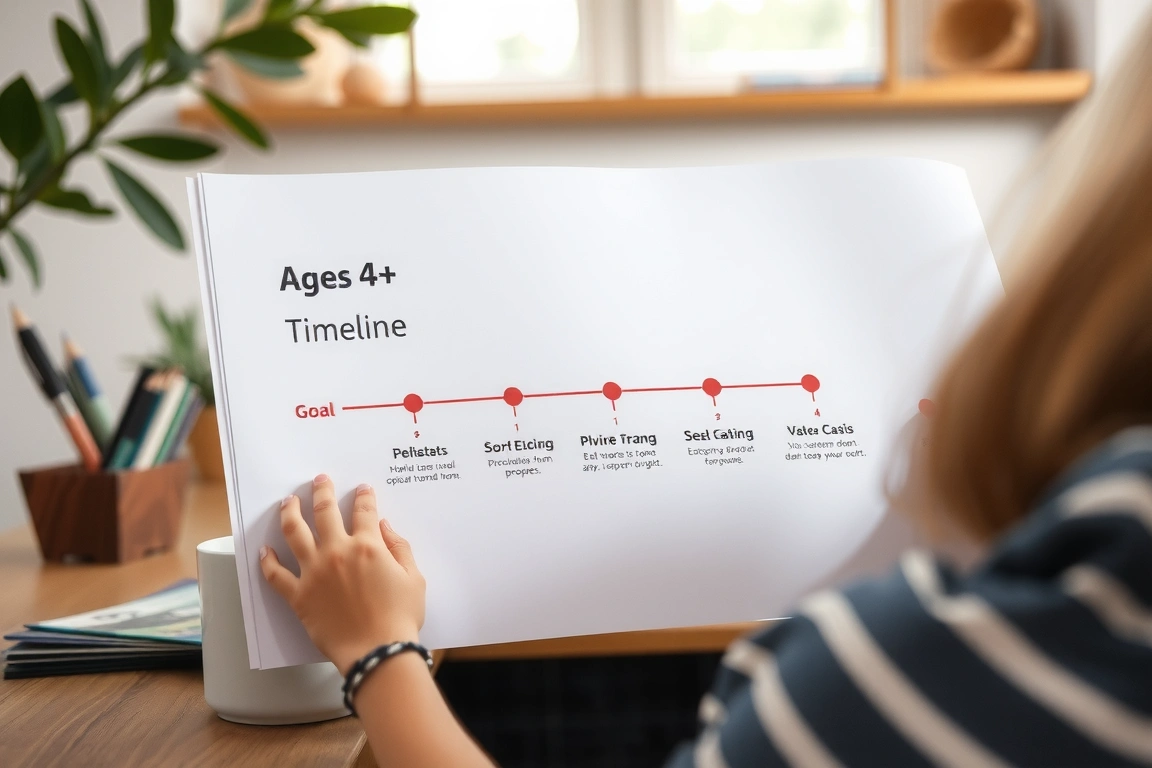
Materials: large paper or poster board, markers, ruler or straight edge, small images or stickers (dollar store has theme packs for $1–$3 each), and optional printable milestone cards. Budget: $6–$10. The digital alternative: use a free online tool like Canva.com/pro/” target=”_blank” rel=”nofollow sponsored noopener”>Canva.com/pro/” target=”_blank” rel=”nofollow sponsored noopener”>Canva.com/pro/” target=”_blank” rel=”nofollow sponsored noopener”>Canva.com/pro/” target=”_blank” rel=”nofollow sponsored noopener”>Canva.com/pro/” target=”_blank” rel=”nofollow sponsored noopener”>Canva.com/pro/” target=”_blank” rel=”nofollow sponsored noopener”>Canva.com/pro/” target=”_blank” rel=”nofollow sponsored noopener”>Canva (free version) or print a 2024–2025 calendar grid and mark it together.
Draw a horizontal line across the paper to represent the year or season. Divide it into 12 months or four seasons—whatever your family understands. For younger kids, keep it seasonal: “September when school starts,” “Winter when it's cold,” “Spring when flowers grow,” “Summer for vacation.” For older kids, use actual months. Then, for each family goal, place it where it will actually happen. If one goal is “go camping,” place it in July. If it's “learn a new skill,” maybe that's December when the kids have time off.
Have each person draw or place a sticker representing their piece of the goal. So if camping is the goal, the 10-year-old draws a tent, the 6-year-old adds trees, the parent adds a campfire. The visual becomes something kids can point to and say, “That's our plan,” which is deeply satisfying. It also surfaces timing issues you might've missed. If you see all five goals clustered in December and nothing in summer, you can redistribute.
Tape this somewhere visible for 30 days, then move it if you want. The real win is that kids check it. They see the goal is real and getting closer. One parent told me her 7-year-old kept pointing at “visit Grandma” placed in March and saying, “It's coming, it's almost here.” That's buy-in. That's motivation built on visibility, not nagging.
The Goal-Tracking Chart Activity (Ages 5+)
Setting a goal is exciting. Tracking it is boring. That's why most families fail. But tracking doesn't have to be tedious. This activity creates a visible tracker that kids actually want to interact with, and it takes about 20 minutes to set up monthly. The tracker lives in plain sight and becomes part of the daily rhythm rather than a chore you remember once every three months.
You need a large calendar grid (print free templates from websites like timeanddate.com, or buy a 12-month dry-erase calendar from Dollar Tree for $3), markers, and small reward stickers or stamps. Optional but powerful: let kids decorate the border with drawings or stickers. Budget: $4–$7 depending on whether you print or buy. For a budget version, draw a grid on large paper yourself—it takes 10 minutes and honestly, kids enjoy it more because it's less “official.”
Here's where most families mess this up: they track too much. Pick one goal per family member, maximum two. If you track everything, it becomes overwhelming and demoralizing when someone misses a day. Pick the one that's most important or most fun to track. If the goal is “cook dinner together weekly,” mark on the calendar which nights that happened. If it's “read aloud for 20 minutes,” mark nights that happened. If it's “go to the park,” mark park days.
Make the system visible and easy. Don't ask kids to write paragraphs. Use a sticker, a checkmark, or a color-in square. One parent I know uses a dry-erase calendar and lets her kids draw tiny doodles in each square on nights they did the activity—a little book for reading nights, a tree for outdoor time, a pot for cooking. The doodle takes 10 seconds but makes the tracking feel like play rather than reporting.
Check the tracker on Sunday nights for 2 minutes, not as judgment but as acknowledgment. “Oh, I see we read together three times this week. That's amazing.” No shame about the four days you didn't. When there's a pattern of missing days, ask what got in the way. Was it too ambitious? Did something else take priority? Does the timing need to change? That conversation—where you're problem-solving instead of scolding—is where the learning actually happens.
The Goal-Statement Activity (Ages 7+)
This is for kids who are ready to think past immediate rewards and understand their own motivation. It takes 30 minutes and produces a personal goal statement each child keeps. Unlike generic goal-setting worksheets, this one focuses on why a goal matters, not just what you want to achieve. That “why” is what keeps kids going when motivation fades.

You need plain paper, markers or colored pencils ($5 for a decent set if you're buying new), and optional: a poster board to display the statements if your kids are into that. The printable templates from Family Flourish walk kids through a fill-in-the-blank structure, but you can also just have a conversation and take notes.
The structure is simple: My goal is ________. I want to do this because __________. One thing that might be hard is __________. I know I can do it because __________. For example, an 8-year-old might write: “My goal is to be nicer to my brother. I want to do this because I miss when we have fun together instead of fighting. One thing that might be hard is remembering when I'm angry. I know I can do it because Dad and I practiced deep breaths and it helps.” That last sentence—”I know I can do it because”—is the magic. It's not optimism; it's specific evidence from that kid's own life.
Have kids illustrate the statement with a picture, then display it somewhere they see it regularly, not as pressure but as presence. A 9-year-old I know taped hers to her desk. When she got frustrated with a goal, she'd look at it and remember the reason. For some kids, that's enough. For others, it's helpful to mention it during conversation: “I remember your goal was learning an instrument. How's that going?” The mention keeps it alive.
The Obstacle-Planning Activity (Ages 6+)
Here's what the cheerful goal-setting websites don't tell you: almost every goal hits a wall. Kids get busy, life happens, motivation fades, or unexpected obstacles pop up. Instead of acting shocked when that happens, plan for it. This activity is short—20 minutes—and feels less like “planning for failure” and more like “being smart about real life.”
Materials: paper, markers, and a simple printed sheet listing common obstacles. Budget: $1–$2 for printing costs. You could also just talk through this verbally and take notes. The conversation is the activity, not the paper.
Pick one family goal. Then, go through these questions: What could get in the way? For “read together three times a week,” the obstacles might be “someone has an activity,” “we're too tired,” or “someone's not in the mood.” Brainstorm 3–4 realistic obstacles. Don't minimize them. This is the honest part. Then, for each obstacle, say: “If that happens, here's what we'll do instead.” If an activity comes up one night, maybe you read the next morning. If you're too tired, maybe it's five minutes instead of 20. If someone's not in the mood, maybe they pick the book that week and that's their buy-in.
Write these backup plans down. This sounds simple, but I've watched it change everything. When an obstacle actually hits (and it will), kids don't feel like the goal is broken. They feel like you already thought of this. You already had a plan. That's the difference between a goal that survives the real world and one that crumbles at the first inconvenience.
One parent told me that planning obstacles ahead of time made her 10-year-old so much more resilient. When soccer season started and family time got squeezed, the kid said, “Oh, this is one of the obstacles we talked about. Let's do the backup plan.” That's a child who's learning to adapt within commitment, not abandon it at the first rough patch.
The Goal-Check-In Meeting (Ages 5+, Quarterly)
Annual goal-setting sessions are great, but they're too far apart to sustain momentum. The quarterly check-in is where goals actually happen. This is a 30-minute conversation, ideally over a meal or snack, where you pause and ask: How are we doing? What's working? What do we want to adjust? It's not a test; it's a conversation. Schedule it for the same time each quarter—September, December, March, June—so it becomes expected, not surprising.
Materials: the original goals poster or document (laminated or in a sleeve so it lasts), a notebook, and maybe a simple printed checklist. Budget: $0 if you already have the original materials. This takes virtually no prep. The power is in the conversation itself, not the format.
Start by acknowledging what worked. Spend real time here. Don't rush to the hard stuff. “We did read together 45 times this quarter. That's wild. You read 14 chapter books as a family.” Let kids own that. Then ask: What felt good about that? Why do you think it worked? When kids explain why something worked, they understand their own motivation. They're not just following a plan; they're seeing cause and effect in their own behavior.
Then ask: What was hard? Be real about this too. Maybe the goal was too ambitious. Maybe circumstances changed. Maybe someone lost interest. This isn't failure; it's data. A goal that taught you something about your family's real capacity and interests is a successful goal, even if you didn't hit 100 percent. Adjust the goal if it needs adjusting. It's not cheating; it's being smart. You're aiming for a goal that fits your life, not a life that bends to an arbitrary goal.
End with: What's one thing you want to keep doing? What's one thing you want to start doing differently? This keeps the focus forward. You're not dwelling on what didn't work; you're building on what did. One family I know does this check-in at their quarterly pizza night. They bring the goal poster to the table, eat pizza, and talk. The setting matters less than the consistency. Same time, same quarter, same conversation.
The Family Values Sorting Activity (Ages 4+)
Goals are usually about doing. Values are about being. This activity bridges the gap by helping families identify what actually matters, which makes the goals you choose feel authentic instead of borrowed from someone else's Pinterest board. It takes about 40 minutes
Related from our network
Why is family goal setting so different from personal goal setting?
It’s way more complex! You're not just dealing with one person's priorities. You've got a mix of ages, motivations, and schedules all under one roof. The magic happens when you connect those individual goals to a shared purpose, which creates a compounding effect and reduces daily conflict.
What are the real benefits of setting goals as a family?
Research shows it’s a total game-changer. Families that do this see measurable improvements in communication and motivation. Kids often report higher self-esteem, and parents experience less stress around daily decisions because everyone’s moving toward a common vision together.
Don't most New Year's resolutions fail? How is this different?
Absolutely, most fail because they're too rigid or too vague! These activities are built for real, messy family life. They’re flexible, designed for different ages, and focus on progress—not perfection—so you can actually stick with them beyond February.
What if my kids are very different ages? Can we still do this?
Yes! That’s the whole point. The best activities are tailored for different age groups. You’ll find specific ideas to get your toddler, teen, and everyone in between engaged and excited about what you’re building together as a family.
Your Weekly Dose of Inspiration
Journaling ideas, family tips, and gentle inspiration.
Related from our network

